 Dynamo Gills
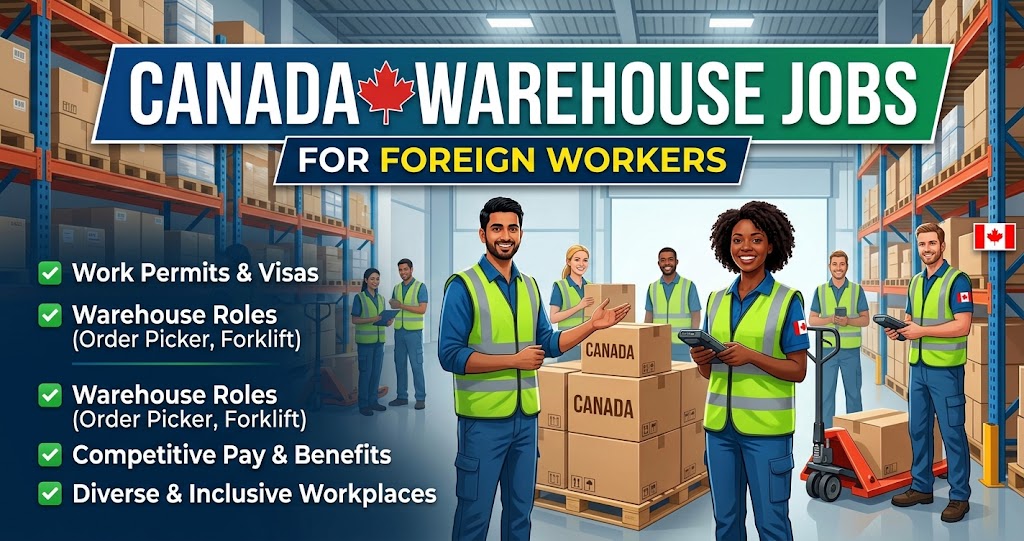
Canada Warehouse Jobs for Foreign Workers remain a potential employment route for people outside Canada who have experience in warehousing, logistics, inventory handling, order fulfillment, distribution or material handling. However, obtaining a Canadian warehouse position from abroad is not simply a matter of finding an employer willing to hire you.
Foreign workers generally need the appropriate Canadian work authorization, and many employer-specific jobs require the Canadian employer to complete additional immigration-related steps before the worker can apply for a work permit.
For warehouse workers, the most important terms to understand are LMIA, employer-specific work permit, Temporary Foreign Worker Program, employer sponsorship, material handler, logistics, distribution and job offer.
Canada’s official immigration guidance explains that an employer-specific work permit normally requires a job offer, while the employer may also need a Labour Market Impact Assessment (LMIA).
This distinction is important because advertisements claiming that every warehouse job comes with “visa sponsorship” can be misleading. A genuine employer-sponsored position must fit Canada’s immigration rules, and the employer must meet applicable requirements.
Important: Immigration rules, LMIA policies, wage thresholds and regional restrictions can change. Always verify the latest requirements through the official Government of Canada websites before paying anyone, accepting an offer or submitting an immigration application.
Table of Contents
- Canada warehouse jobs for foreign workers explained
- Common warehouse positions available in Canada
- Warehouse worker wages and employment conditions
- Do warehouse jobs require an LMIA?
- How employer sponsorship works
- Canada’s 2026 low-wage LMIA restrictions
- Rural warehouse employment and temporary 2026 measures
- Work permit requirements for foreign warehouse workers
- Documents you may need
- How to find legitimate Canadian warehouse jobs
- How to identify a genuine employer-sponsored job
- Application process from outside Canada
- Can warehouse work lead to permanent residence?
- Common mistakes foreign applicants should avoid
- Frequently asked questions
- Official Canadian immigration resources
- Final checklist for applicants
- Author Box
Canada Warehouse Jobs for Foreign Workers Explained
Warehouse employment covers a broad range of activities within Canada’s transportation, storage, manufacturing, retail and distribution industries.
The Government of Canada’s Job Bank identifies Material Handlers (NOC 75101) as workers who move, load and unload materials using manual methods or material-handling equipment. These workers can be employed by transportation and storage companies, manufacturing and processing businesses, and retail and wholesale warehouses.
Potential job titles can include:
- Warehouse worker
- Material handler
- Warehouse associate
- Order picker
- Warehouse labourer
- Shipping and receiving clerk
- Distribution centre worker
- Inventory assistant
- Stock handler
- Packaging worker
- Loading and unloading worker
- Fulfillment associate
Actual duties and occupational classification matter more than the job title itself. Applicants should compare the duties in a job advertisement with the applicable National Occupational Classification before assuming that two similarly named positions have identical immigration treatment.
Common Warehouse Positions Available in Canada
Warehouse operations are much broader than simply moving boxes.
Depending on the employer, a worker could be responsible for receiving shipments, preparing customer orders, packaging products, checking inventory, loading trucks, maintaining warehouse records or operating material-handling equipment.
Material Handler
Material handlers move products and materials within warehouses, factories, distribution facilities and other workplaces.
Job Bank indicates that the occupation generally involves on-the-job training and that formal education is often not required, although some secondary-school education may be required depending on the position. Physical strength can be necessary for workers handling heavy materials.
Order Picker and Fulfillment Worker
Order-picking roles typically involve locating products, preparing customer orders, scanning items and moving completed orders to shipping areas.
These positions are increasingly associated with e-commerce and large distribution operations.
Shipping and Receiving Worker
Shipping and receiving employees may inspect incoming products, prepare outgoing shipments, verify quantities, organize documentation and coordinate loading activities.
Warehouse Equipment Operator
Some warehouses use forklifts, pallet trucks, conveyors and other equipment. Employers may require workers to have relevant training or workplace certification before operating certain equipment.
Applicants should never claim to possess a certification they do not have.
Inventory and Warehouse Support Roles
Some warehouse positions involve stock counts, inventory systems, scanning, labeling, data entry and quality control.
These roles can be particularly useful for candidates who have both warehouse experience and basic computer skills.
Warehouse Worker Wages and Employment Conditions
Salary is one of the most important factors when evaluating Canadian employment opportunities.
Job Bank’s national profile for Material Handlers reported a median wage of $22 per hour in its August 2026 data. The actual wage offered to a worker can vary significantly by province, employer, occupation, experience, shift, location and job duties.
For example, warehouse employees may receive different compensation depending on whether they work:
- Day shifts
- Night shifts
- Weekend shifts
- Overtime schedules
- Cold-storage facilities
- Manufacturing warehouses
- E-commerce fulfillment centres
- Distribution centres
- Transportation facilities
Applicants should focus on the actual written employment offer, rather than relying on generalized salary figures found on social media.
A legitimate employment offer should clearly explain important terms such as wages, deductions, job duties and working conditions. Canadian immigration guidance specifically identifies these details as important components of employment documentation for employer-specific work permits.
Do Warehouse Jobs Require an LMIA?
Not every Canadian warehouse job requires an LMIA, but many employer-sponsored positions can involve one.
A Labour Market Impact Assessment is an assessment used by Employment and Social Development Canada to determine whether there is a need for a temporary foreign worker and whether hiring that worker is expected to have a positive or neutral impact on Canada’s labour market.
For an employer-specific work permit, the employer must determine whether an LMIA is required. If one is required, the employer generally applies for it and provides the foreign worker with the required documents after receiving a positive result.
This means a foreign applicant generally cannot simply obtain an LMIA independently and then search for any Canadian warehouse job.
The employer and the specific position are central to the process.
Official Government of Canada: Employer-specific work permits
How Employer Sponsorship Works for Warehouse Workers
“Employer sponsorship” is commonly used by job seekers to describe a situation in which a Canadian employer supports a foreign worker’s immigration or work authorization process.
For many warehouse workers, this can involve the employer:
- Offering a genuine job
- Meeting applicable recruitment requirements
- Determining whether an LMIA is required
- Applying for an LMIA when necessary
- Providing the required employment documents
- Supporting the worker’s employer-specific work permit application
The employer must also meet government requirements concerning the legitimacy of the business and employment offer.
The Government of Canada states that LMIA applications assess whether the business provides a good or service in Canada, whether the employment need is reasonable and whether the employer can fulfill the terms of the job offer, including wages and other financial obligations.
This is why foreign applicants should be cautious about third parties promising guaranteed warehouse sponsorship in exchange for large upfront payments.
Canada’s 2026 Low-Wage LMIA Restrictions
One of the most important developments for Canada Warehouse Jobs for Foreign Workers in 2026 is the tighter treatment of low-wage positions under the Temporary Foreign Worker Program.
The Government of Canada currently states that there is generally a 10% cap on the proportion of temporary foreign workers an employer can hire in low-wage positions at a specific work location, subject to stated sector-specific variations and other rules.
The government also states that certain low-wage LMIA applications will not be processed when the workplace is located in a census metropolitan area with an unemployment rate of 6% or higher, subject to applicable exceptions. The relevant unemployment rates were updated in July 2026.
These rules matter enormously for warehouse applicants because many entry-level warehouse positions can fall into lower-wage categories depending on the occupation, location and wage offered.
Therefore, a candidate should not assume that an employer can obtain an LMIA simply because the company has a labour shortage.
The employer must satisfy the applicable program requirements at the time of application.
Government of Canada: Low-wage Temporary Foreign Worker Program requirements
Rural Warehouse Employment and Temporary 2026 Measures
There is an important distinction between urban and rural employment under Canada’s temporary 2026 measures.
From April 1, 2026, to March 31, 2027, eligible employers in participating rural areas outside census metropolitan areas may qualify for temporary measures affecting the proportion of low-wage temporary foreign workers they can employ.
Under these measures, eligible employers may be able to retain their existing proportion of low-wage temporary foreign workers above the usual cap or benefit from a 15% cap instead of the usual 10% cap, depending on the circumstances and participating jurisdiction.
These measures do not mean that every rural warehouse employer can automatically sponsor foreign workers.
Employers must still meet Temporary Foreign Worker Program requirements and demonstrate efforts to recruit Canadians and permanent residents first.
The participating provinces and territories and their implementation dates also differ, so applicants should verify the current status for the specific employer and location.
Government of Canada: Temporary measures under the Temporary Foreign Worker Program
Work Permit Requirements for Foreign Warehouse Workers
Most foreign nationals who want to work temporarily in Canada require a work permit unless they fall within a specific exemption.
For a typical employer-sponsored warehouse position, the relevant option is often an employer-specific work permit.
This type of permit identifies conditions such as the employer, location and occupation, and the worker must comply with the conditions stated on the permit.
The basic process can look like this:
Job offer → employer immigration process → LMIA where required → work permit application → decision → travel and employment
An employer-specific work permit is different from an open work permit.
An open work permit does not normally require a specific job offer, but eligibility is limited to particular circumstances.
Documents You May Need
Applicants should expect immigration authorities to request evidence showing that they qualify for both the job and the work permit.
Depending on the circumstances, documents may include:
- Valid passport
- Job offer letter
- Employment contract
- LMIA documentation where applicable
- Proof of previous employment
- Reference letters
- Pay records or other evidence of work experience
- Resume
- Evidence of qualifications
- Police certificates where required
- Medical examination documents where required
- Proof of identity
- Application forms and supporting documents
The Government of Canada states that applicants for employer-specific work permits may need documents such as employment letters, reference letters, proof of work experience and evidence that they meet job requirements.
Do not submit false employment records, fabricated reference letters or altered documents.
Providing misleading information can seriously damage an immigration application.
How to Find Legitimate Canadian Warehouse Jobs
One of the safest starting points is the Government of Canada’s Job Bank, particularly its resources for foreign candidates.
Job Bank specifically warns that people outside Canada who are not legally authorized to work cannot apply for every job listed on the platform. It also directs foreign candidates toward employers recruiting internationally.
When searching, use combinations of keywords such as:
- Warehouse worker
- Material handler
- Warehouse associate
- Distribution centre worker
- Shipping and receiving
- Order picker
- Fulfillment associate
- Logistics worker
- Warehouse labourer
- Inventory worker
Then examine the advertisement carefully.
Look for information about:
- Employer name
- Work location
- Wage
- Hours
- Job duties
- Required experience
- Application instructions
- Whether the employer accepts international applicants
- Whether work authorization is required
Do not assume that a job advertisement mentioning “visa sponsorship” is automatically legitimate.
How to Identify a Genuine Employer-Sponsored Job
A genuine employment opportunity should withstand basic verification.
Start by researching the employer independently.
Check whether the company has:
- A legitimate business presence
- A verifiable website
- A physical business location
- Consistent corporate information
- A professional recruitment process
- Contact information that matches the company
- A job advertisement that corresponds to an actual business need
Be particularly cautious if someone claims that you can obtain a Canadian work permit by paying them personally for a guaranteed LMIA.
Canadian employers and recruitment arrangements are subject to specific rules, including restrictions concerning recruitment fees charged to temporary foreign workers. The government also conducts assessments of employer legitimacy under the TFW Program.
A legitimate immigration process is not the same thing as a guaranteed visa.
Application Process From Outside Canada
For a foreign warehouse worker applying from outside Canada, the process generally begins with identifying a legitimate job opportunity.
Secure a genuine job offer
The position should come from a legitimate Canadian employer and accurately describe the job.
Determine whether an LMIA is required
The employer—not the foreign applicant—must determine the appropriate immigration pathway for the position.
If an LMIA is required, the employer applies for it through the appropriate process.
Receive the required employment documents
For an LMIA-required employer-specific work permit, the worker may need the positive LMIA documentation, job offer and employment contract.
Submit the work permit application
The applicant then applies through the appropriate IRCC process and provides the required supporting documentation.
Complete biometrics or medical requirements where applicable
Depending on the applicant and circumstances, IRCC may require biometrics, a medical examination or additional documentation.
Wait for the immigration decision
Do not purchase expensive non-refundable travel arrangements based solely on a job advertisement or verbal promise.
Travel after authorization
A foreign worker should travel for employment only after receiving the required authorization and following the conditions attached to it.
Official Government of Canada: Apply for a work permit
Can Warehouse Work Lead to Permanent Residence?
A warehouse job does not automatically provide permanent residence in Canada.
However, employment in Canada can potentially become relevant to future immigration options depending on the worker’s occupation, work experience, language ability, education, province, employer and eligibility under a particular immigration program.
The exact pathway matters.
For example, some provincial nominee programs have their own requirements, while federal economic immigration programs have specific occupational, work-experience and language criteria.
Applicants should therefore avoid advertisements promising that a warehouse job automatically guarantees Canadian permanent residence.
A job offer and a work permit are not the same as permanent resident status.
The Government of Canada also explains that job-offer rules differ among economic immigration programs.
Why Warehouse Applicants Should Understand NOC Codes
The National Occupational Classification (NOC) is important because immigration programs use occupational classifications to determine how jobs are categorized.
Material handlers, for example, are classified under NOC 75101 in the current Canadian occupational system.
Applicants should compare:
Job title + duties + NOC classification + immigration program requirements
rather than relying on the job title alone.
This is particularly important when a recruitment advertisement uses vague titles such as “warehouse assistant” or “logistics worker.”
The actual duties may determine the appropriate classification.
Common Mistakes Foreign Warehouse Applicants Should Avoid
Paying for a guaranteed job or visa
No legitimate recruiter should be able to guarantee that Canadian immigration authorities will approve your application.
Assuming every warehouse job qualifies for LMIA sponsorship
LMIA approval depends on government requirements, employer circumstances, wage levels, location and the applicable program.
Ignoring the wage
The wage offered can determine whether the employer’s LMIA application falls under the high-wage or low-wage stream. Canada’s official guidance states that the applicable stream is determined by comparing the offered wage with the provincial or territorial hourly wage threshold.
Applying without checking work authorization
A job advertisement does not itself give a foreign applicant permission to work in Canada.
Using fake documents
False documents or misleading information can create serious immigration consequences.
Confusing an LMIA with a work permit
An LMIA and a work permit are different parts of the process.
Where an LMIA is required, the employer generally obtains the LMIA before the worker applies for the corresponding employer-specific work permit.
Ignoring location-specific restrictions
A position in one Canadian region may face different conditions from a similar position elsewhere because of wage levels, unemployment rates and temporary program measures.
Frequently Asked Questions
Can foreigners get warehouse jobs in Canada?
Yes, foreign nationals can work in Canadian warehouses if they qualify for the applicable work authorization and the employer and position meet Canadian employment and immigration requirements.
However, not every warehouse vacancy is available to foreign workers.
Do warehouse jobs in Canada offer LMIA sponsorship?
Some employers may use the Temporary Foreign Worker Program where they meet the requirements for an LMIA-supported position. However, LMIA availability is not automatic and is affected by wage, location, occupation, employer and program rules.
Is an LMIA the same as visa sponsorship?
No. An LMIA is an assessment related to hiring a foreign worker. A work permit is the authorization that allows the foreign national to work under specified conditions.
Can I apply for a Canadian warehouse job without a work permit?
Foreign candidates can apply for jobs from outside Canada, but an employer’s willingness to hire them does not itself authorize them to work in Canada. The appropriate work permit must be obtained before employment begins unless an exemption applies.
How much do warehouse workers earn in Canada?
Job Bank reported a national median wage of approximately $22 per hour for Material Handlers in August 2026. Individual job offers can differ based on province, employer, experience, duties, shifts and other factors.
Do I need a university degree for warehouse work?
Not necessarily. Job Bank indicates that material-handler positions generally involve on-the-job training and may require little formal education, although some positions can have additional requirements.
Can a warehouse job lead to permanent residence?
Potentially, but there is no automatic pathway from a warehouse job to permanent residence. Eligibility depends on the specific federal or provincial immigration program and the applicant’s circumstances.
Are rural warehouse jobs easier for foreign workers?
Rural areas have received temporary measures for certain low-wage TFW positions during 2026–2027, but those measures apply only under specified conditions and participating jurisdictions. They do not guarantee LMIA approval or a work permit.
Official Canadian Immigration Resources
Foreign applicants should prioritize official government information over social-media recruiters or unofficial immigration blogs.
Useful government resources include:
Canada.ca — Employer-specific work permits
Canada.ca — Temporary Foreign Worker Program and LMIA information
Canada.ca — Low-wage Temporary Foreign Worker Program requirements
Canada.ca — Temporary 2026 rural measures
Final Checklist for Foreign Warehouse Job Applicants
Before applying for Canada Warehouse Jobs for Foreign Workers, check the following:
- The employer is a real Canadian business.
- The job advertisement contains clear duties and employment conditions.
- The wage is clearly stated.
- The position matches your actual experience.
- You understand the applicable NOC classification.
- You have checked whether the employer recruits foreign workers.
- You understand whether an LMIA may be required.
- You understand the difference between an LMIA and a work permit.
- You have not paid someone for a guaranteed visa.
- You have not submitted false documents.
- You have checked current Government of Canada requirements.
- You understand that a job offer does not automatically guarantee a work permit.
- You have verified the latest rules before submitting an application.
Final Thoughts
Canada Warehouse Jobs for Foreign Workers in 2026 can provide opportunities in material handling, logistics, distribution, fulfillment, shipping, receiving and related areas. But the immigration side of the process has become more important as Canada has tightened rules affecting low-wage temporary foreign workers.
For prospective applicants, the most important strategy is to separate a real Canadian employment opportunity from a generic online promise of “visa sponsorship.”
Start with legitimate employers and government-backed employment resources. Understand the job duties, wage and location. Determine which immigration process applies. If an LMIA is required, remember that the Canadian employer is responsible for the LMIA process. If approved, the foreign worker still needs to satisfy the requirements for the appropriate work permit.
Most importantly, verify current requirements directly through IRCC, Employment and Social Development Canada and Job Bank before making financial commitments.
Immigration rules can change during the year, so information published in an older job advertisement should never override the current requirements published by the Government of Canada.
Author Box
Dynamo Gills
Writer & Researcher at Jobs Biodynasty
Dynamo Gills researches international employment, immigration pathways, scholarships and global career opportunities, with a focus on providing practical, source-based information for readers exploring work and study opportunities abroad.


 Dynamo Gills