 Dynamo Gills
Explore entry-level jobs in Canada for foreign workers in 2026, including work permits, LMIA requirements, Job Bank opportunities, wages, application tips and immigration pathways.
Canada continues to attract international workers looking for employment opportunities, career development and longer-term immigration options. For people without extensive Canadian work experience, entry-level jobs in Canada for foreign workers can provide a starting point for building local experience, earning an income and understanding the Canadian labour market.
However, finding an entry-level job is only one part of the process. Most foreign nationals need authorization to work in Canada, and the requirements can vary depending on the job, employer, immigration program and type of work permit involved.
Some Canadian employers recruit temporary foreign workers through the Temporary Foreign Worker Program (TFWP), while other employment situations may fall under the International Mobility Program (IMP) or another immigration category. In many cases, an employer-specific work permit requires a Labour Market Impact Assessment (LMIA), although exemptions exist.
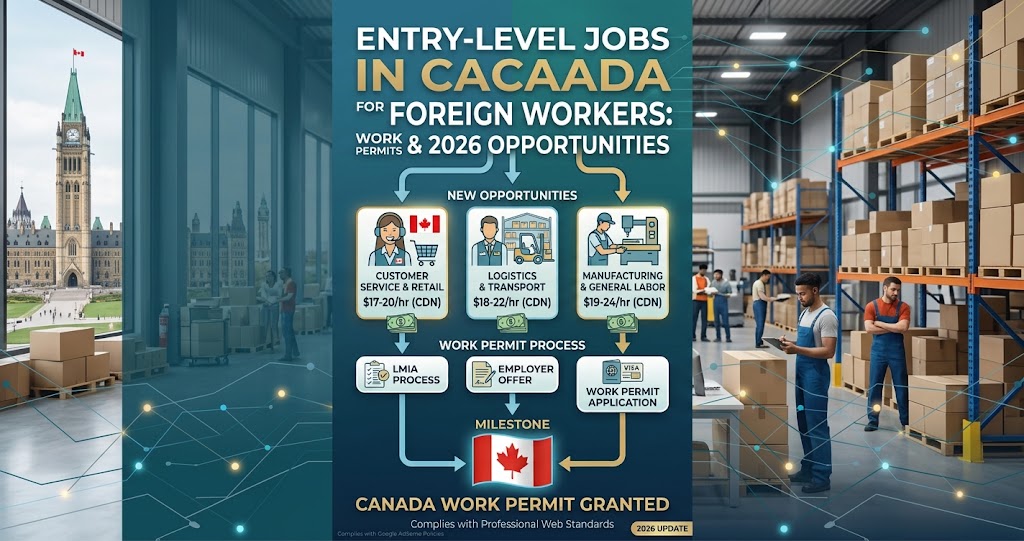
This guide explains how entry-level employment works for foreign workers in 2026, where to look for legitimate opportunities, how work permits and LMIA requirements fit together, what types of jobs may be available and how to avoid common recruitment scams.
Table of Contents
- What Are Entry-Level Jobs in Canada?
- Can Foreign Workers Get Entry-Level Jobs in Canada?
- Do You Need a Canadian Work Permit?
- How LMIA Work Permits Work
- Entry-Level Jobs Canadian Employers May Advertise
- How Much Can Entry-Level Workers Earn?
- Where to Find Jobs for Foreign Workers in Canada
- How to Apply for Canadian Jobs From Abroad
- Entry-Level Jobs and Permanent Residence
- How to Protect Yourself From Job Scams
- Documents to Prepare Before Applying
- Practical Strategies for Finding Work in Canada in 2026
- Frequently Asked Questions
- Final Thoughts
1. What Are Entry-Level Jobs in Canada?
Entry-level jobs generally refer to positions that require limited professional experience, relatively short training or basic occupational skills.
The term does not necessarily mean that the job requires no qualifications. Certain positions can require safety training, licences, language ability, physical capability, previous experience or occupation-specific certification.
Examples can include positions in:
- Food service
- Hospitality
- Warehousing
- Manufacturing
- Agriculture
- Cleaning and housekeeping
- Retail
- Customer service
- General labour
- Construction support
- Transportation and logistics
- Caregiving and support services
The actual requirements depend on the employer and occupation.
For example, Canada’s Job Bank identifies food service workers as an occupational group that includes food counter attendants, kitchen helpers, dishwashers and related support workers. Job Bank states that this occupation usually involves on-the-job training and does not generally require formal education.
That can make some entry-level occupations accessible to candidates who are building their first Canadian employment experience.
2. Can Foreign Workers Get Entry-Level Jobs in Canada?
Yes, foreign nationals can potentially obtain Canadian employment, but having an attractive job vacancy does not automatically give someone the legal right to work in Canada.
Most foreign nationals require a work permit unless they fall within a specific exemption. Canada’s immigration authorities state that most foreign nationals need a work permit to work in Canada, although certain categories of workers can qualify for exemptions.
For someone outside Canada, the most important distinction is between:
An employer-specific work permit:
This normally authorizes the worker to work under specified conditions, such as the employer, occupation and location.
An open work permit:
This can provide broader authorization to work for an employer, subject to the conditions attached to the permit.
The correct option depends on the applicant’s immigration circumstances.
A person should therefore avoid assuming that an employer’s willingness to hire them automatically means they can begin working immediately.
3. Do You Need a Canadian Work Permit?
In most cases, yes.
Canada’s official immigration guidance explains that most foreign nationals need a work permit to work in Canada. There are, however, specific exemptions for certain occupations and situations.
For someone searching for entry-level jobs from outside Canada, the safest approach is to determine the work authorization requirements before accepting employment or travelling to Canada for work.
Employer-specific work permits
An employer-specific work permit can restrict a worker to the employer and employment conditions listed on the permit.
For many temporary foreign worker positions, the employer must first obtain an LMIA unless the position qualifies for an exemption. Canada’s official guidance states that employers generally need to determine whether an LMIA is required and, where necessary, obtain a positive LMIA before the foreign worker applies for the work permit.
Open work permits
Open work permits are available only to people who meet specific eligibility requirements. They are not simply an alternative that every foreign job applicant can choose.
This distinction is important because online advertisements sometimes use phrases such as “Canada open work permit jobs” without explaining whether the advertised position actually provides eligibility for an open work permit.
Always verify the immigration category through the Government of Canada before paying money or submitting sensitive documents.
4. How LMIA Work Permits Work
One of the most important terms for foreign workers searching for Canadian employment is LMIA, which stands for Labour Market Impact Assessment.
An LMIA is used to assess the effect of hiring a temporary foreign worker on Canada’s labour market.
According to the Government of Canada, a positive LMIA confirms that there is a need for a temporary foreign worker and that Canadians or permanent residents are not available to fill the position under the assessment.
Does every Canadian job require an LMIA?
No.
Some jobs may be exempt from the LMIA requirement under Canada’s immigration rules. Employers may hire temporary foreign workers through the TFWP when an LMIA is required, or through programs such as the International Mobility Program when the position qualifies for an exemption.
Therefore, a job advertised as “LMIA jobs in Canada” should not be interpreted as meaning that every foreign worker will automatically receive a work permit.
The employer, occupation and immigration circumstances matter.
Who applies for the LMIA?
Generally, the employer is responsible for the LMIA process.
The Government of Canada provides employers with an online system for submitting LMIA applications to Service Canada.
A foreign worker should be particularly cautious if a recruiter claims that the worker personally needs to “purchase” an LMIA.
Canada’s Job Bank explicitly states that employers should not ask workers to pay for an LMIA.
5. Entry-Level Jobs Canadian Employers May Advertise
The availability of jobs changes continuously by province, occupation and employer. Consequently, applicants should treat job titles as examples rather than guarantees of recruitment.
1. Food Service Jobs
Food service can include:
- Kitchen helper
- Food counter attendant
- Dishwasher
- Food service worker
- Restaurant support worker
Job Bank currently describes food service work as an occupation that generally involves on-the-job training and no formal education requirement.
This can make the sector relevant to people searching for entry-level employment.
2. Warehouse and Logistics Jobs
Warehouse-related positions can include:
- Warehouse associate
- Material handler
- Order picker
- Shipping and receiving assistant
- Inventory assistant
Applicants may need physical stamina, basic computer skills, safety awareness or experience with warehouse equipment depending on the position.
3. General Labour Jobs
General labour opportunities may appear in:
- Manufacturing
- Agriculture
- Construction
- Processing
- Packaging
- Landscaping
The precise requirements can vary significantly between employers.
4. Hospitality and Housekeeping
Hotels and accommodation businesses may advertise positions such as:
- Housekeeping attendant
- Hotel cleaner
- Room attendant
- Laundry attendant
- Hospitality support worker
These jobs may emphasize reliability, attention to detail and customer-service skills.
5. Agriculture and Farm Work
Agricultural employers may recruit workers for:
- Crop production
- Greenhouses
- Harvesting
- Farm labour
- Food processing
Agricultural employment can involve specific federal or seasonal programs, so applicants should examine the immigration and employment conditions associated with the particular job.
6. Construction Support Jobs
Construction-related entry-level positions may include labourer and construction support roles.
Applicants should understand that some trades require formal apprenticeship training, certification or licensing. A general labour position should not be confused with a regulated skilled trade.
6. How Much Can Entry-Level Workers Earn?
Salary should be evaluated according to the occupation, province, experience, employer, working hours and prevailing wage requirements.
There is no single “Canada entry-level salary.”
For example, Job Bank’s wage information for food service workers lists a Canadian median wage of $16.55 per hour, based on its published wage data. The figures vary across provinces and communities.
Job postings can also differ substantially.
Current Job Bank listings for employers recruiting temporary foreign workers demonstrate this variation. Recent postings have included food service positions, housekeeping roles, farm labour and transportation-related positions with different advertised wage rates.
Therefore, applicants should never judge a job solely by an advertised annual salary.
Before accepting an offer, examine:
- Hourly wage
- Guaranteed hours
- Overtime conditions
- Location
- Accommodation costs
- Transportation
- Tax deductions
- Benefits
- Contract duration
- Probation period
- Work permit conditions
A high hourly rate in an expensive city may produce a different financial outcome from a lower rate in a smaller community.
7. Where to Find Jobs for Foreign Workers in Canada
One of the safest starting points is the Government of Canada’s Job Bank.
The Job Bank has a dedicated section for temporary foreign workers, allowing candidates to search postings from Canadian employers that have obtained or applied for an LMIA.
Search Canadian jobs through the official Job Bank
Job Bank postings can provide useful information such as:
- Employer name
- Job title
- Location
- Salary
- Date posted
- Application method
- LMIA status where applicable
Job Bank also warns applicants that employers should never ask them to pay to obtain employment.
Search using specific job titles
Instead of searching only for “Canada jobs for foreigners,” use targeted terms such as:
- Warehouse associate
- Food service worker
- Kitchen helper
- General labourer
- Farm worker
- Housekeeping attendant
- Production worker
- Construction labourer
- Truck driver
Job Bank itself provides examples including administrative assistant, cook, farm worker and truck driver when explaining how temporary foreign workers can refine their searches.
8. How to Apply for Canadian Jobs From Abroad
Foreign applicants should approach the process like a professional international recruitment exercise.
Step 1: Identify suitable occupations
Choose jobs that genuinely match your experience, education, physical abilities and transferable skills.
Step 2: Build a Canadian-style resume
A strong resume should normally be concise and focused on measurable responsibilities and achievements.
For example:
Instead of:
“Worked in a warehouse.”
Use:
“Processed incoming inventory, prepared customer orders and maintained accurate stock records in a high-volume warehouse environment.”
Step 3: Check employer information
Research the employer before providing personal information or signing documents.
Look for:
- Official company website
- Physical business presence
- Consistent contact information
- Job posting details
- Employment conditions
- Government registration information where appropriate
Step 4: Verify immigration requirements
Do not assume that a job advertisement equals work-permit eligibility.
Use the official Government of Canada immigration website to determine the applicable work permit requirements.
Canada work permit information from IRCC
Step 5: Apply through legitimate channels
Use the employer’s official careers page, Job Bank or another established recruitment platform.
Step 6: Keep copies of documents
Save copies of:
- Resume
- Job advertisement
- Employment offer
- Employment contract
- Emails
- Employer contact information
- Immigration documents
- Payment receipts, where legitimate government fees apply
This documentation can become important if a dispute arises.
9. Entry-Level Jobs and Permanent Residence
Some foreign workers are interested in using Canadian employment as part of a longer-term immigration strategy.
However, an entry-level job does not automatically lead to permanent residence.
Canada has several economic immigration programs, including Express Entry-managed programs and Provincial Nominee Programs (PNPs).
The Canadian Experience Class, for example, has specific requirements concerning qualifying Canadian work experience. Canada’s current Express Entry information states that Canadian Experience Class applicants generally need one year of Canadian work experience within the previous three years, subject to the program’s detailed requirements.
Provincial Nominee Programs operate differently.
Canada’s PNP system allows participating provinces and territories to nominate candidates who meet their specific requirements and who intend to live in the nominating jurisdiction.
Some PNP streams focus on skilled or semi-skilled workers, graduates and other groups, but eligibility varies significantly.
A provincial nomination also does not itself mean that someone can immediately begin working. Canada’s official guidance notes that a person may still need a work permit to work while their permanent residence application is being processed.
Therefore, anyone considering permanent residence should evaluate the immigration program separately from the job offer.
10. How to Protect Yourself From Job Scams
International job seekers are frequently targeted by fraudulent recruitment advertisements.
Be cautious when someone promises:
- Guaranteed Canadian employment
- Guaranteed visa approval
- Guaranteed permanent residence
- Guaranteed high salary
- Guaranteed LMIA
- Immediate work authorization
- A government job without a proper recruitment process
A legitimate job offer should contain meaningful information about the employer, position, compensation, work location and employment conditions.
Never assume an “LMIA fee” is legitimate
The Government of Canada states that employers must not make temporary foreign workers pay the LMIA fee.
Similarly, applicants should be cautious about recruiters requesting large payments for a supposed “job slot,” “visa sponsorship certificate” or “guaranteed employment package.”
Know your rights
Canada provides protections for temporary foreign workers.
Government guidance states that temporary foreign workers have workplace rights and can use Job Bank resources to search for alternative employment. It also provides mechanisms for reporting abuse.
Learn about temporary foreign worker rights in Canada
11. Documents to Prepare Before Applying
Having documents ready can make international applications easier.
Depending on the job and immigration pathway, candidates may need:
- Valid passport
- Professional resume
- Employment reference letters
- Educational certificates
- Trade certificates
- Professional licences
- Language-test results where applicable
- Police certificates where required
- Medical examination documents where required
- Employment offer or contract
- Work permit application documents
- Proof of relevant work experience
Do not submit documents that contain false information.
Immigration applications can involve serious legal consequences if an applicant misrepresents material information.
12. Practical Strategies for Finding Work in Canada in 2026
The Canadian employment market is competitive, so applicants can improve their search process by being selective.
Focus on transferable skills
A foreign applicant does not necessarily need previous Canadian employment experience for every entry-level occupation.
Transferable skills can include:
- Customer service
- Communication
- Inventory management
- Food preparation
- Equipment operation
- Workplace safety
- Cleaning
- Basic computer skills
- Teamwork
- Time management
Explain these skills clearly on your resume.
Search outside Canada’s largest cities
Do not limit your search to Toronto, Vancouver or Montreal.
Job opportunities exist across Canada’s provinces and territories, and employers in smaller communities may have different labour-market needs.
The Government of Canada’s Job Bank allows candidates to search by location and occupation.
Read the entire job advertisement
Look for:
- Minimum qualifications
- Required experience
- Wage
- Working hours
- Location
- Transportation
- Accommodation information
- Language requirements
- Application deadline
- LMIA status
Apply strategically
Sending hundreds of identical applications may be less useful than submitting carefully tailored applications to employers whose requirements match your experience.
A practical weekly strategy could involve:
- Finding 20 relevant vacancies.
- Eliminating positions that clearly do not match your qualifications.
- Researching each employer.
- Customizing your resume.
- Writing a concise application message.
- Tracking applications in a spreadsheet.
- Following up professionally when appropriate.
13. Frequently Asked Questions
What are the best entry-level jobs in Canada for foreign workers?
There is no single job that is best for everyone. Food service, hospitality, agriculture, warehousing, manufacturing, general labour and some construction-support occupations can provide entry-level opportunities, depending on employer demand and immigration eligibility.
Can I get a Canadian work permit without an LMIA?
Potentially, yes. Some work permit categories are LMIA-exempt. The applicable exemption depends on the worker’s circumstances and the immigration program.
Can I apply for Canada jobs from outside Canada?
Yes. Employers can recruit international candidates, and Job Bank provides information and job-search resources for foreign candidates. However, being selected for a job does not automatically grant authorization to work in Canada.
How do I find LMIA jobs in Canada?
Start with the official Job Bank temporary foreign worker search and examine individual postings for LMIA information. Job Bank indicates whether an employer has requested or received an LMIA in relevant postings.
Does an entry-level job guarantee permanent residence?
No. Permanent residence has separate eligibility requirements. Some Canadian work experience may be relevant to certain immigration programs, but applicants must satisfy the requirements of the particular program.
Can an employer charge me for an LMIA?
A worker should not be required to pay the employer’s LMIA fee. Canada’s Job Bank specifically warns that employers cannot make temporary foreign workers pay for an LMIA.
Where can I verify Canadian immigration information?
Use the official Government of Canada immigration website rather than relying exclusively on social-media posts, recruiters or third-party websites.
Official Government of Canada immigration and citizenship website
14. Final Thoughts
Entry-Level Jobs in Canada for Foreign Workers can provide an important starting point for people seeking international employment, but the process requires more than finding an attractive vacancy.
Foreign applicants need to understand their work authorization, investigate employers, compare compensation and employment conditions, prepare a professional application and verify immigration information through official government sources.
For many applicants, the Government of Canada’s Job Bank is a useful starting point because its temporary foreign worker section identifies employers seeking international workers and provides information about job locations, wages and LMIA status.
The most important principle is simple: a legitimate Canadian job search should never depend on promises of guaranteed visas, guaranteed permanent residence or guaranteed employment.
Research the employer, understand the immigration pathway and verify every important claim through Canada’s official immigration resources before making financial or travel commitments.
Official Resources
- Government of Canada — Work in Canada
- Government of Canada — Employer-Specific Work Permits
- Government of Canada — Labour Market Impact Assessment Information
- Canada Job Bank — Temporary Foreign Workers
- Government of Canada — Provincial Nominee Program
Author Box
Dynamo Gills
Writer & Researcher at Jobs Biodynasty
Dynamo Gills writes about international employment, career development, immigration-related opportunities and practical job-search strategies for readers exploring global career options.


 Dynamo Gills