 Dynamo Gills
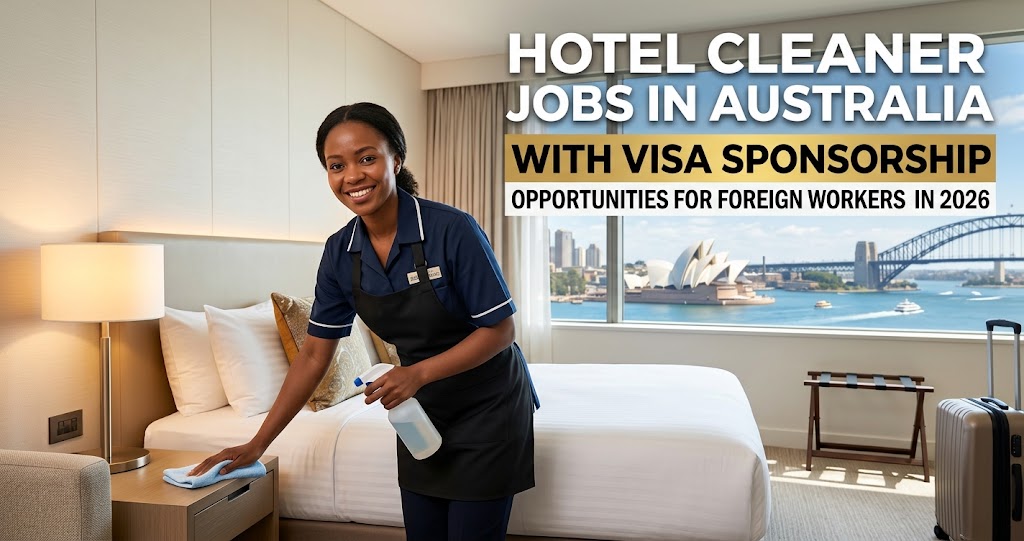
Hotel Cleaner Jobs in Australia With Visa Sponsorship are attracting interest from international job seekers looking for accessible employment opportunities in Australia’s hospitality and accommodation sector. However, foreign workers should understand an important distinction: finding a hotel-cleaning vacancy is not the same as finding a position that qualifies for employer-sponsored migration.
Australia has a large accommodation and hospitality industry, and cleaning work is performed across hotels, resorts, serviced apartments, motels and other accommodation businesses. Jobs and Skills Australia reports approximately 150,100 people employed as Commercial Cleaners, with accommodation and food services among the industries employing workers in this occupational group. Its latest available profile reports median full-time earnings of $1,254 per week and median hourly earnings of $33, based on the cited 2025 earnings data.
At the same time, Australia’s employer-sponsored visa system is occupation- and visa-specific. The Skills in Demand visa (subclass 482), for example, requires an approved sponsor, an eligible nominated occupation and other requirements. Therefore, applicants should not assume that an ordinary hotel cleaner position automatically qualifies for a standard skilled visa.
This guide explains how hotel cleaning jobs work in Australia, what foreign workers can realistically expect to earn, which visa pathways may be relevant, how employer sponsorship works, where to search for legitimate vacancies, and how to avoid recruitment scams.
Table of Contents
- Why Hotel Cleaning Jobs Are Available in Australia
- What Hotel Cleaners Do
- Hotel Cleaner Salary and Employment Conditions
- Are Hotel Cleaner Jobs Eligible for Visa Sponsorship?
- The Skills in Demand Visa and Hotel Cleaning
- Labour Agreements and DAMA Opportunities
- Working Holiday Visas for Eligible Applicants
- PALM Opportunities for Eligible Pacific Workers
- Requirements for Hotel Cleaning Jobs
- How Foreign Workers Can Search for Jobs
- How to Prepare an Australian-Style Application
- Documents You May Need
- Australian Workplace Rights for Foreign Workers
- How to Identify Genuine Employer Sponsorship
- Hotel Cleaning Jobs in Major Australian Locations
- How to Improve Your Employment Prospects
- Common Mistakes to Avoid
- Frequently Asked Questions
- Final Thoughts
- Author Box
Why Hotel Cleaning Jobs Are Available in Australia
Hotels depend on reliable housekeeping and cleaning teams to maintain rooms and public areas to an acceptable standard. This creates employment opportunities across different types of accommodation businesses.
Commercial cleaning is also a significant Australian occupation. Jobs and Skills Australia lists accommodation and food services among the industries in which Commercial Cleaners work. The occupation includes duties such as vacuuming, cleaning furniture and fixtures, removing rubbish, disinfecting bathrooms and replenishing supplies.
Hotel cleaning may therefore involve considerably more than simply making beds.
Depending on the employer, a housekeeper or room attendant may be responsible for:
- Cleaning and preparing guest rooms
- Changing bed linen and towels
- Cleaning bathrooms
- Vacuuming and mopping floors
- Dusting furniture and fixtures
- Replenishing toiletries and guest supplies
- Removing rubbish
- Reporting maintenance problems
- Following infection-control and workplace hygiene procedures
- Cleaning public areas
- Working with housekeeping supervisors
- Meeting room-cleaning time and quality requirements
The precise duties depend on the hotel, position and applicable employment arrangement.
What Hotel Cleaners Do
A hotel cleaner may work under titles such as:
- Hotel Cleaner
- Room Attendant
- Housekeeper
- Hotel Housekeeping Attendant
- Accommodation Cleaner
- Guest Room Attendant
- Public Area Cleaner
- Housekeeping Attendant
- Resort Cleaner
- Cleaning Services Employee
Job titles should not be confused with immigration occupation classifications. Australian immigration authorities assess visa applications according to the relevant visa rules, occupation requirements and nominated role rather than simply accepting a job title written in an advertisement.
This distinction is particularly important for foreign applicants searching for Hotel Cleaner Jobs in Australia With Visa Sponsorship.
A vacancy advertised as “housekeeper” or “room attendant” does not necessarily mean that the employer can sponsor the successful applicant for a skilled visa.
Hotel Cleaner Salary and Employment Conditions
Pay depends on the employer, location, employment arrangement, classification, working hours and applicable award or enterprise agreement.
Jobs and Skills Australia’s Commercial Cleaners profile reports median full-time earnings of $1,254 per week and median hourly earnings of $33, using the data sources specified on its occupation profile. These figures are occupation-wide statistics rather than a guaranteed salary for hotel cleaners.
Workers should therefore avoid advertisements that promise a particular annual salary without explaining the employment arrangement and hours.
Understanding Australian minimum pay
Australia has legally enforceable minimum employment standards. Modern awards can establish minimum rates, penalty rates, allowances and other conditions.
For contract cleaning businesses, the Cleaning Services Award may apply. Fair Work explains that the award covers employers in the contract cleaning services industry and employees falling within its classifications. It also notes that cleaners employed directly by a hotel may instead fall under another applicable award, depending on the circumstances.
The Hospitality Award covers employers in Australia’s hospitality industry, including hotels, motels, resorts and other accommodation businesses. Its classifications include housekeepers and guest-service employees, with particular classifications covering accommodation cleaning.
Because award coverage depends on the employer and actual duties, workers should check the applicable award rather than relying on a generic online salary figure.
Are Hotel Cleaner Jobs Eligible for Visa Sponsorship?
This is one of the most important questions for international applicants.
Not every hotel cleaner job qualifies for employer-sponsored migration.
Australia’s standard skilled migration system is based on specific occupations and visa criteria. The Skills in Demand visa (subclass 482), for example, allows an approved employer to sponsor a suitably skilled overseas worker for an eligible nominated position. The applicant must satisfy requirements relating to the nominated occupation, experience, English and other criteria.
Consequently, an applicant should not pay a recruiter simply because an advertisement says “visa sponsorship available.”
Instead, ask:
- What visa subclass is being used?
- What occupation is being nominated?
- Is the employer an approved sponsor?
- Is the position eligible under that visa pathway?
- Does the applicant meet the visa requirements?
- Is sponsorship actually included in the written employment offer?
- Who pays which recruitment, nomination and visa costs?
- Is the job located in a region covered by a relevant labour agreement?
These questions can prevent expensive mistakes.
The Skills in Demand Visa and Hotel Cleaning
The Skills in Demand visa (subclass 482) is one of Australia’s principal temporary employer-sponsored work visas.
Home Affairs states that the visa allows an employer to sponsor a suitably skilled worker to fill a position they cannot fill with a suitably skilled Australian worker. The visa has Core Skills, Specialist Skills and Labour Agreement streams, each with different eligibility rules.
For a standard hotel-cleaning position, applicants should first establish whether the actual occupation and position meet the requirements of the relevant stream.
The fact that a hotel is willing to employ someone does not, by itself, create visa eligibility.
The Labour Agreement stream can be particularly relevant to situations where an employer has an approved Labour Agreement. Home Affairs states that this stream is for skilled workers nominated by employers that have a Labour Agreement and requires the nominated occupation to be specified under that agreement.
Labour Agreements and DAMA Opportunities
For some foreign workers, regional migration arrangements may be worth investigating.
Australia’s Designated Area Migration Agreement (DAMA) framework allows designated regions to access a broader range of overseas workers than may be available through the standard skilled migration program.
Home Affairs explains that DAMAs can provide access to additional occupations and may include negotiated concessions to certain visa requirements. Individuals cannot apply for a DAMA directly; they need an employer in the designated region to sponsor them for an occupation specified in the relevant agreement.
This can make regional hospitality employment an area worth researching.
However, applicants should never assume that every regional hotel can sponsor cleaners. The specific DAMA, occupation, employer and visa requirements must be checked.
There are currently multiple DAMA arrangements across Australia, and their occupation lists and conditions differ. Home Affairs publishes the current arrangements and links to the relevant regional authorities.
Working Holiday Visas for Eligible Applicants
A Working Holiday Maker pathway may provide another way for eligible foreign nationals to undertake short-term hotel and hospitality employment.
The Working Holiday visa (subclass 417) is designed for eligible young adults who want to holiday in Australia while working to help fund their stay.
Home Affairs states that applicants generally must be aged 18 to 30, or 35 for certain countries, and must hold a passport from an eligible country or jurisdiction. The first visa permits a 12-month stay, subject to the visa requirements and conditions.
Importantly, this is not the same thing as employer sponsorship.
A person working in a hotel on a Working Holiday visa is using an existing work-authorised visa rather than necessarily being sponsored by the hotel.
Applicants should check the current passport-country requirements before making travel plans because eligibility varies.
PALM Opportunities for Eligible Pacific Workers
The Pacific Australia Labour Mobility (PALM) scheme is another distinct pathway.
The PALM stream of the Temporary Work (International Relations) visa (subclass 403) permits eligible workers from participating Pacific countries and Timor-Leste to work for approved PALM employers.
Home Affairs states that PALM workers can undertake short-term contracts of up to nine months or long-term contracts of up to four years, subject to the applicable program conditions. Workers must be citizens and residents of participating PALM countries and have an approved employment placement.
Government material also identifies hospitality and tourism among sectors in which opportunities for eligible Pacific and Timor-Leste workers can arise.
This does not mean every hotel-cleaning vacancy is available through PALM. The employer must participate in the scheme and the position must be approved under its arrangements.
Requirements for Hotel Cleaning Jobs
Hotel employers may have different hiring requirements, but applicants should generally be prepared to demonstrate:
Previous cleaning or housekeeping experience
Experience in hotels, resorts, hospitals, commercial cleaning, residential cleaning or similar environments can strengthen an application.
Physical ability
Hotel cleaning can involve standing, bending, lifting, pushing cleaning equipment and completing repetitive tasks.
Attention to detail
Room attendants must follow cleaning checklists and maintain consistent standards.
Reliability
Hotels operate around guest check-in and check-out schedules, meaning punctuality and dependable attendance are important.
Communication skills
Basic English communication can be important for understanding instructions, reporting maintenance issues and communicating with supervisors and colleagues.
Workplace safety awareness
Applicants should understand safe handling of cleaning chemicals, equipment and workplace hazards.
Legal work rights
A foreign worker must hold a visa that permits the proposed employment. Employers and applicants should verify visa conditions before employment begins.
How Foreign Workers Can Search for Jobs
A practical job search should begin with legitimate employment channels rather than social-media advertisements promising guaranteed visas.
Search terms can include:
- “hotel cleaner Australia”
- “room attendant Australia”
- “hotel housekeeping jobs Australia”
- “accommodation cleaner Australia”
- “housekeeping attendant Australia”
- “hotel jobs regional Australia”
- “visa sponsorship hospitality Australia”
- “employer sponsored hospitality jobs Australia”
- “DAMA hospitality jobs Australia”
- “PALM hospitality jobs”
Use established Australian employment websites, individual hotel career pages, recruitment companies with verifiable operations and the Australian Government’s employment resources.
The Australian Government’s Visa Finder can also help applicants identify visa categories based on the type of work and circumstances.
How to Prepare an Australian-Style Application
A strong application should be simple, factual and easy for a hiring manager to understand.
A resume for a hotel-cleaning role can include:
Professional summary
Briefly describe your cleaning or hospitality experience.
Employment history
List employers, job titles, dates and responsibilities.
Relevant skills
Include room cleaning, housekeeping, laundry handling, sanitation, chemical safety, teamwork and time management where applicable.
Education and training
Include relevant certificates or workplace training.
References
Provide professional references where available and where it is appropriate to do so.
Avoid making unsupported claims such as “guaranteed visa sponsorship” or “eligible for Australian permanent residence.”
The immigration status of an applicant should be handled separately from the description of their work experience.
Documents You May Need
The precise documents depend on the visa and job.
Potential documents can include:
- Valid passport
- Resume or CV
- Employment references
- Evidence of previous work experience
- Educational or vocational certificates
- English-language evidence where required
- Police certificates where required
- Health examinations where required
- Visa application documents
- Employment contract or offer
- Employer nomination information where applicable
Applicants should follow the document requirements published by the Department of Home Affairs for their particular visa.
The official Australian immigration website should be treated as the primary source for visa requirements rather than social-media posts or recruitment advertisements.
Official immigration source: Australian Department of Home Affairs — Work in Australia and visa information
Australian Workplace Rights for Foreign Workers
Foreign workers in Australia have workplace protections.
Fair Work states that awards establish minimum pay rates and conditions for covered employees. These can include ordinary rates, penalty rates, overtime, allowances, breaks and other employment conditions.
For example, the Fair Work Ombudsman states that employees covered by the Cleaning Award cannot be paid less than the applicable minimum rate and may receive additional payments depending on the type and timing of their work.
Fair Work’s current information also demonstrates why applicants should not automatically accept a flat hourly rate without checking the applicable award and classification.
Official workplace rights source: Fair Work Ombudsman — Employee pay and workplace rights
Foreign workers should also know that an employer cannot simply cancel an Australian visa. Home Affairs states that visa cancellation decisions are made by Australian Government decision-makers.
How to Identify Genuine Employer Sponsorship
A genuine sponsorship opportunity should have identifiable details.
Before accepting an offer, ask the employer or authorised migration professional for:
- Full legal employer name
- Australian business details
- Position title
- Workplace location
- Employment conditions
- Salary or hourly rate
- Expected hours
- Proposed visa pathway
- Sponsorship or nomination information
- Written employment documentation
- Contact details for the business
Be especially cautious when a person promises:
- Guaranteed Australian permanent residence
- Guaranteed visa approval
- A job without an interview
- A visa in exchange for an unexplained cash payment
- A sponsorship certificate that can supposedly be purchased
- A high salary that is inconsistent with the duties
- A visa without meeting immigration requirements
Home Affairs also provides information about migrant-worker protections and reporting workplace exploitation.
Hotel Cleaning Jobs in Major Australian Locations
Hotel-cleaning opportunities can arise wherever there is a significant accommodation industry.
Potential locations include:
Sydney
Sydney has a large hotel and tourism market, with employment across hotels, serviced apartments and accommodation businesses.
Melbourne
Melbourne’s accommodation industry creates opportunities across city hotels, events-related accommodation and surrounding tourism areas.
Brisbane
Brisbane has a growing accommodation and tourism market, with jobs also extending into surrounding areas.
Gold Coast
The Gold Coast’s tourism-oriented economy creates demand for housekeeping and accommodation services.
Perth
Perth offers opportunities across hotels, resorts, serviced apartments and commercial accommodation.
Regional Australia
Regional locations can be particularly relevant when researching employer-sponsored or DAMA-related opportunities because some regional migration arrangements operate within defined geographic boundaries.
However, location alone does not make a position eligible for sponsorship.
How to Improve Your Employment Prospects
Foreign workers can improve their competitiveness by developing skills that hotels genuinely need.
Useful areas include:
Professional housekeeping
Learn modern room-servicing procedures and quality-control standards.
Commercial cleaning
Experience with professional equipment can help applicants qualify for a wider range of cleaning roles.
Chemical safety
Understanding correct handling, storage and use of cleaning products is valuable.
Customer service
Hotel workers may interact directly with guests, making professional communication important.
Laundry operations
Some housekeeping positions combine room servicing with linen and laundry duties.
Supervisory skills
Experienced cleaners may eventually progress into housekeeping team-leader or supervisor positions.
Career progression can also create opportunities beyond entry-level cleaning, although each new occupation has its own qualifications, duties and immigration considerations.
Common Mistakes to Avoid
One of the biggest mistakes is assuming that every advertisement mentioning “sponsorship” represents an approved immigration pathway.
Other mistakes include:
- Applying without checking visa eligibility
- Paying an unknown individual for a supposed sponsorship certificate
- Using false work experience
- Submitting inconsistent information
- Ignoring Australian workplace laws
- Accepting cash-only employment without understanding the legal implications
- Assuming a Working Holiday visa is employer sponsorship
- Assuming regional employment automatically leads to permanent residence
- Relying on outdated visa information
- Confusing a hotel job with an eligible skilled occupation
The Australian immigration system changes over time, so applicants should verify requirements immediately before submitting a visa application.
Frequently Asked Questions
Can foreigners get hotel cleaner jobs in Australia?
Yes, foreign nationals can work in Australian hotels if they hold a visa that permits the proposed employment. The available pathways depend on the applicant’s nationality, circumstances, occupation and visa eligibility.
Does every hotel cleaner job offer visa sponsorship?
No. A hotel vacancy and an employer-sponsored migration position are not automatically the same thing. Sponsorship depends on the applicable visa program, nominated occupation, employer eligibility and the applicant meeting the relevant requirements.
Can a hotel sponsor a cleaner under the Skills in Demand visa?
It depends on the nominated occupation, visa stream and applicable rules. Applicants should not assume that a standard hotel-cleaning position qualifies for the Skills in Demand visa simply because an employer is willing to hire them. Home Affairs requires specific eligibility criteria for sponsored positions.
What is a DAMA?
A Designated Area Migration Agreement is a regional migration arrangement that can give participating regions access to additional occupations and certain concessions under negotiated terms. Individuals cannot directly apply for a DAMA; an eligible employer must sponsor the worker under the applicable arrangement.
Can Working Holiday visa holders work in hotels?
Eligible Working Holiday visa holders can work in Australia subject to the conditions of their visa. The subclass 417 program is intended for eligible young adults from participating countries and jurisdictions.
How much can a hotel cleaner earn in Australia?
There is no single national hotel-cleaner salary. Pay depends on classification, employer, hours, location, employment type and applicable award or agreement. Jobs and Skills Australia’s Commercial Cleaners profile reports median full-time earnings of $1,254 per week and median hourly earnings of $33 for the occupation using its cited data sources.
Where can I check Australian visa requirements?
Use the Australian Department of Home Affairs website and its visa finder rather than relying solely on recruitment advertisements.
Can an employer charge me for sponsorship?
Applicants should be extremely cautious about requests for money connected to supposed sponsorship. Verify exactly what a payment is for and whether it is legally payable before transferring funds. Australian immigration and workplace rules contain specific obligations for employers and visa applicants.
Final Thoughts
Hotel Cleaner Jobs in Australia With Visa Sponsorship can be a legitimate search category for international workers, but the phrase “visa sponsorship” should never be treated as a guarantee of an Australian work visa.
Australia has a substantial cleaning and accommodation industry, and official labour-market data confirm that commercial cleaning is a sizeable occupation. Hotels, resorts, motels and other accommodation businesses employ people in housekeeping and cleaning roles.
The immigration question is more complicated.
A conventional hotel-cleaner vacancy may provide employment but not necessarily qualify for the standard employer-sponsored skilled migration system. Depending on the applicant’s circumstances, relevant alternatives can include an eligible Working Holiday visa, PALM participation for eligible Pacific and Timor-Leste workers, or an employer-sponsored arrangement where the position and employer satisfy the applicable requirements. Labour Agreements and DAMAs may also be relevant in particular circumstances.
The most important step is therefore to verify the actual visa pathway, not simply the job title.
For current immigration rules, applicants should consult the Australian Department of Home Affairs directly:
Australian Department of Home Affairs — official immigration source
For salary, award coverage and workplace rights:
Fair Work Ombudsman — official workplace rights source
And for occupation-level labour-market information:
Jobs and Skills Australia — Commercial Cleaners occupation profile
Applicants should verify all visa requirements, sponsorship arrangements, employment conditions and costs before accepting an offer or paying anyone for immigration assistance.
Author Box
Dynamo Gills
Writer & Researcher at Jobs Biodynasty
Dynamo Gills researches international employment, migration, scholarships and career opportunities, with a focus on providing practical information for workers seeking legitimate opportunities abroad.

 Dynamo Gills