 admin
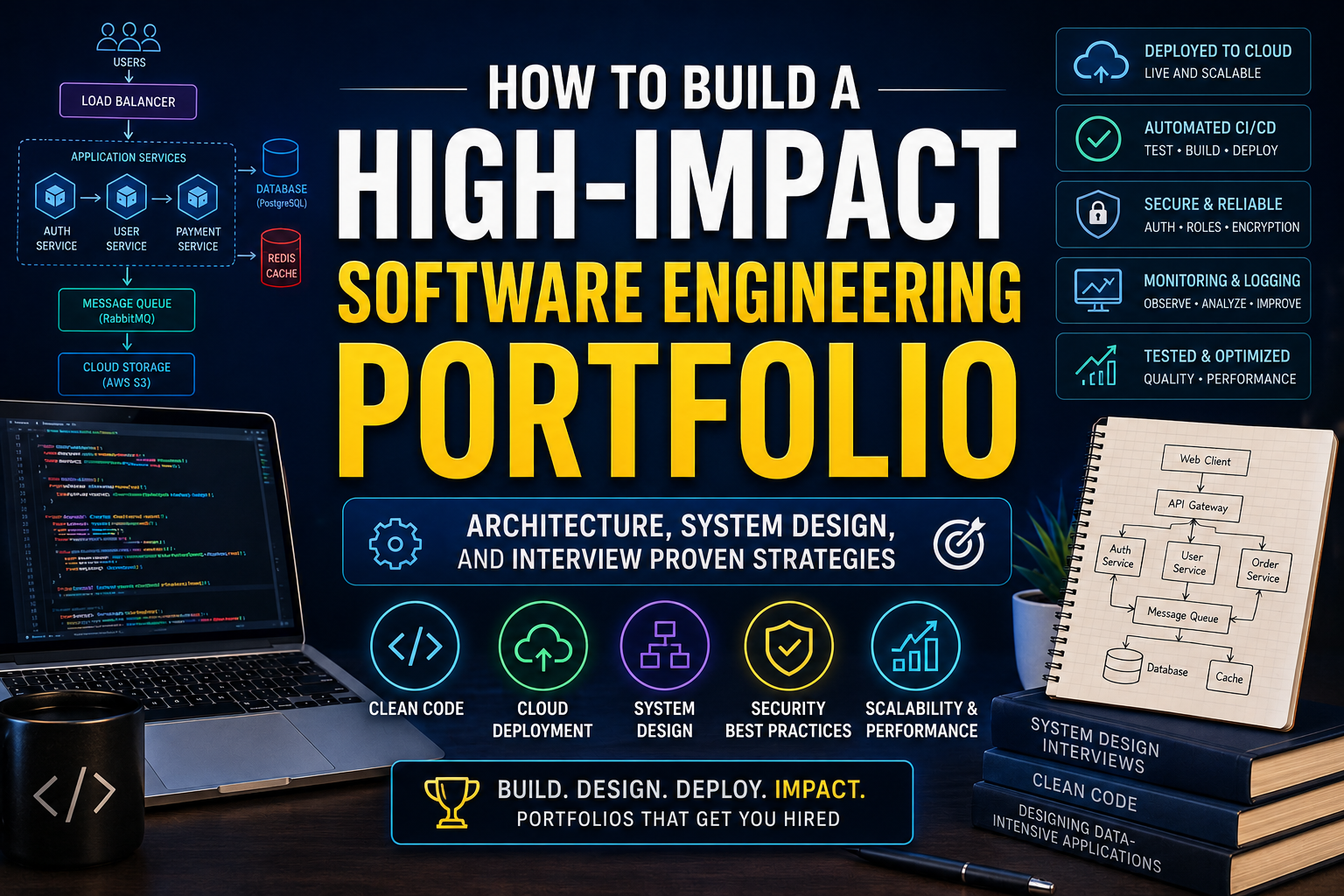
adminLearn how to build a software engineering portfolio that impresses recruiters. Discover architecture best practices, system design principles, GitHub optimization, and interview-winning strategies.
The software engineering job market has evolved dramatically over the past few years. Recruiters are no longer impressed simply by a university degree or a list of programming languages on a résumé. Employers want evidence that you can solve real business problems, write maintainable code, collaborate with others, and design scalable software systems.
Whether you’re applying for entry-level software engineering positions, senior backend roles, cloud engineering jobs, DevOps opportunities, or software architect positions, one factor consistently influences hiring decisions:
A high-quality engineering portfolio.
An outstanding portfolio demonstrates your technical ability long before you walk into an interview. Instead of merely claiming that you understand distributed systems, REST APIs, Docker, Kubernetes, or cloud computing, your portfolio provides tangible proof.
This is especially important because modern hiring processes increasingly emphasize practical skills. Many companies now review GitHub repositories, technical blogs, deployed applications, architecture diagrams, and documentation before scheduling interviews.
A thoughtfully designed portfolio can help you:
- Stand out among hundreds of applicants.
- Demonstrate real-world engineering experience.
- Showcase architecture and system design thinking.
- Highlight coding standards and testing practices.
- Build credibility even without years of professional experience.
- Create talking points for technical interviews.
- Increase opportunities for higher-paying engineering roles.
Rather than focusing on quantity, successful candidates prioritize quality. Five exceptional projects with excellent documentation often outperform fifty unfinished repositories filled with experimental code.
In this guide, you’ll learn how to build a portfolio that reflects the way experienced software engineers think, design, and solve problems.
Why Software Engineering Portfolios Matter More Than Ever
Technology hiring has become increasingly competitive.
Many applicants possess similar educational backgrounds and certifications. What separates one candidate from another is the ability to demonstrate practical engineering skills.
Recruiters typically spend only a short amount of time reviewing an application before deciding whether to move forward. During that initial review, they often look for evidence of:
- Clean code
- Problem-solving ability
- Project ownership
- Documentation quality
- Architecture decisions
- Real-world deployments
- Testing practices
- Collaboration experience
A polished portfolio immediately answers these questions.
Instead of relying on generic claims such as “experienced in Python” or “proficient in Java,” your portfolio illustrates exactly how those technologies were applied to solve meaningful challenges.
What Recruiters Actually Want to See
Many candidates misunderstand the purpose of a software portfolio.
Recruiters rarely expect personal projects to rival commercial products built by large engineering teams.
Instead, they evaluate whether your work demonstrates professional engineering habits.
Strong portfolios typically showcase:
1. Clean Project Structure
Projects should follow logical directory organization.
Example:
src/
tests/
docs/
config/
docker/
scripts/
README.md
LICENSE
Disorganized repositories create the impression of rushed development.
2. Professional Documentation
Documentation often separates average portfolios from exceptional ones.
Every project should explain:
- Project purpose
- Business problem solved
- Architecture overview
- Technologies used
- Installation steps
- API documentation
- Screenshots
- Deployment instructions
- Future improvements
Documentation reflects communication skills, which employers value highly.
3. Real Problem Solving
Avoid creating projects that simply replicate online tutorials.
Instead, build applications that solve genuine problems.
Examples include:
- Appointment scheduling systems
- Inventory management platforms
- Healthcare dashboards
- Learning management systems
- Financial budgeting applications
- Logistics tracking software
- Customer support platforms
- Smart automation tools
Projects with practical applications naturally generate stronger interview discussions.
4. Code Quality
Professional engineers prioritize maintainability over clever shortcuts.
Recruiters appreciate:
- Clear naming conventions
- Modular architecture
- Proper comments
- Consistent formatting
- Error handling
- Logging
- Validation
- Reusable components
Readable code demonstrates maturity.
5. Deployment Experience
Applications should ideally be accessible online.
Deploying projects shows familiarity with production environments.
Common deployment platforms include:
- AWS
- Microsoft Azure
- Google Cloud
- Vercel
- Netlify
- Render
- Railway
Live demos help reviewers quickly evaluate your work.
The Difference Between a Developer Portfolio and an Engineering Portfolio
Many personal websites showcase animations, colorful graphics, and long skill lists.
These may look attractive but often lack engineering depth.
A software engineering portfolio focuses on technical excellence.
Instead of asking:
“Can this person build a website?”
It answers:
“Can this engineer design reliable software systems?”
An engineering portfolio demonstrates:
- Architecture thinking
- Scalability
- Testing
- Security
- Documentation
- Monitoring
- Maintainability
- Performance optimization
Professional engineering is about building systems that continue working as complexity grows.
Start with Quality Instead of Quantity
One common mistake is creating dozens of incomplete projects.
Recruiters rarely review every repository.
Instead, focus on creating three to five polished projects.
Each project should demonstrate a different engineering competency.
For example:
| Project | Demonstrates |
|---|---|
| E-commerce Platform | Backend Architecture |
| Real-Time Chat App | WebSockets & Scalability |
| Task Management API | REST Design |
| Cloud Deployment | DevOps |
| Analytics Dashboard | Frontend Engineering |
This balanced approach showcases versatility while maintaining depth.
Choosing Projects That Employers Value
Not every project contributes equally to your portfolio.
Recruiters prefer applications that mirror business software.
Below are examples that consistently perform well during technical interviews.
SaaS Applications
Software-as-a-Service platforms involve many engineering concepts.
Possible examples include:
- CRM systems
- Project management tools
- Subscription platforms
- HR software
- Invoice management systems
These projects naturally demonstrate authentication, databases, APIs, and cloud deployment.
E-Commerce Platforms
An online store allows you to showcase:
- Authentication
- Shopping carts
- Payments
- Product search
- Recommendation engines
- Admin dashboards
- Inventory management
- Reporting
Healthcare Platforms
Healthcare software introduces interesting engineering challenges.
Examples:
- Appointment booking
- Electronic medical records
- Prescription management
- Patient dashboards
- Telemedicine systems
Such projects also encourage discussions about security and privacy.
Financial Applications
Finance projects demonstrate careful attention to accuracy.
Examples:
- Budget planners
- Investment dashboards
- Expense trackers
- Payment systems
- Banking simulations
These projects require thoughtful validation and secure transaction handling.
Cloud-Based Systems
Cloud-native projects showcase modern engineering skills.
Examples:
- Image processing pipelines
- Video transcoding
- File storage systems
- Serverless applications
- Event-driven workflows
Cloud projects often impress hiring managers because they resemble enterprise environments.
Thinking Like a Software Architect
One of the biggest differences between junior and senior engineers is architectural thinking.
Junior developers often focus on writing features.
Senior engineers ask questions before writing code.
For example:
- Who will use this system?
- How many users should it support?
- What happens if traffic increases?
- How will failures be handled?
- How will data be stored?
- Can services scale independently?
- How will monitoring work?
- What security risks exist?
Including these considerations in your portfolio demonstrates engineering maturity.
Every Project Should Begin with Architecture
Before writing code, create a simple architecture document.
Include:
Problem Statement
Describe the business challenge.
Example:
Small businesses struggle to manage customer appointments efficiently.
Functional Requirements
List what the system should do.
Example:
- User registration
- Appointment scheduling
- Calendar integration
- Notifications
- Admin dashboard
Non-Functional Requirements
These often impress interviewers.
Examples:
- High availability
- Low latency
- Scalability
- Security
- Maintainability
- Performance
- Reliability
High-Level Architecture
Illustrate:
Client

↓

API Gateway

↓

Application Server

↓

Database

↓

Cache

↓

Cloud Storage
Architecture diagrams immediately elevate a portfolio.
Demonstrating System Design Skills
System design interviews have become standard for many software engineering positions.
Your portfolio should naturally prepare you for these discussions.
Each project should explain:
- Why a particular database was selected.
- Why REST was chosen instead of GraphQL.
- Why caching was implemented.
- How background jobs work.
- How scaling could occur.
- Potential bottlenecks.
- Future architectural improvements.
Recruiters appreciate candidates who explain decisions instead of merely listing technologies.
Writing Better README Files
Many portfolios lose credibility because of weak documentation.
An effective README should include:
Overview
Explain what the application does.
Features
Summarize the major capabilities.
Technology Stack
Example:
Frontend:
- React
- TypeScript
- Tailwind CSS
Backend:
- Node.js
- Express
- PostgreSQL
Infrastructure:
- Docker
- Nginx
- AWS
Architecture
Provide a brief explanation of system components.
Installation
Explain how another developer can run the project.
API Documentation
Include sample endpoints.
Screenshots
Visual demonstrations improve credibility.
Future Improvements
Show that you’re thinking beyond version one.
Build Projects That Tell a Story
A memorable portfolio isn’t just a collection of code repositories—it tells the story of how you approach engineering challenges.
For each project, answer questions such as:
- What problem inspired this application?
- Who is the intended user?
- What constraints influenced your design?
- Which trade-offs did you make?
- What did you learn during development?
- If you rebuilt the project today, what would you improve?
This narrative helps interviewers understand your decision-making process, not just your technical skills. It also provides natural conversation starters during interviews.
Common Portfolio Mistakes to Avoid
Even talented developers can weaken their portfolios with avoidable errors. Watch out for these common issues:
- Incomplete projects: Half-finished applications suggest difficulty following through.
- Copied tutorials: Projects that closely mirror online tutorials don’t showcase independent problem-solving.
- Poor documentation: Missing setup instructions or unclear READMEs frustrate reviewers.
- No testing: Applications without tests can raise concerns about code quality.
- Outdated repositories: Long periods of inactivity may make your skills appear stale.
- Broken demo links: Always verify that live applications and documentation are accessible.
- Overly complex designs: Simplicity and clarity often leave a stronger impression than unnecessary complexity.
A clean, reliable portfolio with a handful of polished projects is usually more effective than a large collection of unfinished work.
Advanced Engineering Skills That Make Your Portfolio Stand Out
In Part 1, we covered the foundations of building a portfolio that reflects professional software engineering practices. We explored why recruiters value real-world projects, how to choose meaningful applications, and why architecture, documentation, and clean code matter.
Now it’s time to move beyond simply building applications.
Modern software engineers are expected to understand how software performs in production environments. Employers increasingly look for candidates who can design scalable systems, automate deployments, monitor applications, secure infrastructure, and troubleshoot performance issues.
Your portfolio should communicate that you’re capable of thinking beyond the code editor.
Demonstrate Strong System Design Skills
One of the most effective ways to strengthen your portfolio is by showcasing your ability to design systems—not just write code.
System design focuses on how different components work together to create reliable, scalable, and maintainable software.
Even if you’re applying for a junior or mid-level role, demonstrating structured thinking around architecture can significantly improve your portfolio.
For every major project, include a section explaining:
- The business problem
- Expected user traffic
- Functional requirements
- Non-functional requirements
- Scalability considerations
- Security concerns
- Performance optimizations
- Potential future improvements
This gives recruiters insight into how you approach engineering decisions.
Include Architecture Diagrams
Visual documentation helps reviewers understand your projects quickly.
Simple architecture diagrams are often more effective than lengthy explanations.
A typical web application might include:
Users

↓

Load Balancer

↓

Web Application

↓

Authentication Service

↓

Database

↓

Redis Cache

↓

Cloud Storage

↓

Monitoring Dashboard
If your application uses microservices, illustrate how services communicate.
For example:
- Authentication Service
- User Service
- Product Service
- Payment Service
- Notification Service
Clear diagrams demonstrate planning and communication skills.
Explain Your Technology Choices
Many developers simply list technologies.
Experienced engineers explain why they selected them.
Instead of writing:
Built with PostgreSQL.
Explain:
PostgreSQL was selected because the application required strong transactional consistency, relational data modeling, and advanced indexing capabilities.
Instead of saying:
Used Redis.
Explain:
Redis reduced database load by caching frequently requested user profile data, improving response times.
These explanations show engineering judgment rather than tool familiarity.
Design for Scalability
Recruiters appreciate engineers who consider future growth.
Ask yourself questions such as:
- What happens if users increase from 100 to 100,000?
- Which components become bottlenecks?
- Can services scale independently?
- How will traffic be distributed?
- How will background jobs be processed?
Discussing these considerations demonstrates long-term thinking.
Examples include:
- Horizontal scaling
- Stateless application servers
- Load balancing
- Database replication
- Queue-based processing
- Content delivery networks (CDNs)
Even if your project never reaches production scale, explaining how it could scale is valuable.
Showcase Cloud Engineering Skills
Cloud computing is now central to modern software development.
Employers often seek engineers who understand how applications run in cloud environments.
You don’t need an enterprise infrastructure to demonstrate cloud knowledge.
A personal project deployed to a cloud platform can still highlight practical skills.
Examples include:
- Hosting a backend API
- Deploying a React application
- Using managed databases
- Storing files in cloud storage
- Configuring environment variables
- Setting up HTTPS
- Managing application logs
Document your deployment process so reviewers can understand your workflow.
Containerize Your Applications
Containers make applications portable and consistent across environments.
Adding Docker support to your projects shows an understanding of modern development practices.
A strong repository often includes:
- Dockerfile
- docker-compose.yml
- Environment configuration
- README instructions for local setup
Explain why containerization improves:
- Consistency
- Deployment
- Collaboration
- Testing
- Portability
This demonstrates that your projects are designed for real development teams.
Introduce Continuous Integration and Continuous Deployment (CI/CD)
Professional engineering teams rely on automation.
Including a CI/CD pipeline in your portfolio shows that you understand software delivery, not just development.
Your pipeline might automatically:
- Run tests
- Check code formatting
- Perform linting
- Build the application
- Deploy updates
- Generate documentation
Even a simple automated workflow illustrates professionalism and reduces manual errors.
Mention what your pipeline validates before code is merged or deployed.
Demonstrate API Design Best Practices
Many interview discussions focus on API design.
Each backend project should include well-designed endpoints.
Good APIs typically include:
- Clear resource naming
- Consistent HTTP methods
- Proper status codes
- Validation
- Pagination
- Filtering
- Authentication
- Rate limiting
- Error responses
Instead of exposing dozens of inconsistent endpoints, prioritize clarity and predictability.
Document sample requests and responses so reviewers can quickly understand your implementation.
Security is an essential aspect of software engineering.
Almost every business application requires some form of identity management.
Portfolio projects become more realistic when they include:
- User registration
- Secure login
- Password hashing
- Session management
- Token-based authentication
- Role-based permissions
Examples of roles include:
- Administrator
- Manager
- Customer
- Support Agent
Document how permissions affect application behavior.
Highlight Secure Coding Practices
Security should be visible throughout your portfolio.
Explain how your application addresses common risks, such as:
- Input validation
- SQL injection prevention
- Cross-site scripting (XSS)
- Cross-site request forgery (CSRF)
- Secure password storage
- Sensitive configuration management
- HTTPS enforcement
- Access control
You don’t need to claim that your application is perfectly secure. Instead, demonstrate awareness of secure development principles and the measures you’ve implemented.
Show That You Write Tests
Testing is often overlooked in personal projects, making it an excellent differentiator.
Recruiters generally appreciate seeing:
- Unit tests
- Integration tests
- End-to-end tests
- API tests
Explain what you’re testing and why.
For example:
- Authentication flows
- Payment calculations
- Input validation
- Business rules
- Database operations
Include test coverage information if available, but avoid focusing solely on percentages. Emphasize meaningful test cases over metrics.
Build Logging and Monitoring Into Your Projects
Production software requires visibility.
Show that you’ve considered how engineers diagnose issues.
Your application can include:
- Request logging
- Error logging
- Health check endpoints
- Performance metrics
- Audit logs
Document what information is captured and how it helps identify problems.
This demonstrates operational thinking.
Address Performance Optimization
Performance is about more than making code run quickly.
Discuss how you’ve optimized your applications by considering:
- Efficient database queries
- Indexing strategies
- Pagination
- Lazy loading
- Caching
- Compression
- Asynchronous processing
- Background jobs
Where possible, explain the reasoning behind each optimization rather than simply stating that the application is “fast.”
Demonstrate Database Design Skills
A well-designed database reflects thoughtful engineering.
Include an entity relationship diagram (ERD) or describe your data model.
Explain:
- Primary entities
- Relationships
- Indexes
- Constraints
- Normalization decisions
Also discuss situations where denormalization might improve performance.
These insights show that you understand the trade-offs involved in data modeling.
Add Observability Features
Modern engineering teams prioritize observability to maintain reliable systems.
If practical, demonstrate concepts such as:
- Application metrics
- Request tracing
- Error tracking
- Performance dashboards
- Health checks
Even a simple dashboard displaying response times or error counts can strengthen your portfolio by showing operational awareness.
Include AI-Powered Features Responsibly
Artificial intelligence has become a common component of modern software products.
You don’t need to build an AI model from scratch to demonstrate familiarity with AI integration.
Examples include:
- Intelligent search
- Text summarization
- Chat assistants
- Content categorization
- Image recognition
- Recommendation engines
If you integrate AI services, clearly explain:
- The business problem being solved
- User privacy considerations
- How AI output is validated
- Where human oversight remains important
Avoid overstating AI capabilities. Transparency builds credibility.
Demonstrate Collaboration Skills
Employers hire engineers who can work effectively within teams.
Even if your projects are personal, you can showcase collaboration by using professional workflows such as:
- Feature branches
- Pull requests
- Code reviews (if collaborating with peers)
- Issue tracking
- Project boards
- Milestones
- Semantic commit messages
These practices indicate that you’re familiar with team-based development.
Keep Dependencies Current
Outdated libraries can create security and maintenance risks.
Regularly review your project dependencies and:
- Remove unused packages
- Upgrade supported versions
- Document major changes
- Test compatibility after updates
A maintained project signals ongoing engagement and professionalism.
Write Technical Blog Posts to Complement Your Portfolio
An engineering portfolio becomes even more compelling when accompanied by clear technical writing.
Consider publishing articles about:
- Architectural decisions
- Lessons learned during development
- Performance improvements
- API design choices
- Debugging experiences
- Security considerations
- Deployment strategies
Writing demonstrates communication skills—an important quality for engineers who collaborate across teams.
Present Measurable Results
Whenever possible, include concrete outcomes instead of vague claims.
Examples:
Instead of:
Improved application performance.
Write:
Reduced average API response time by optimizing database queries and introducing server-side caching.
Instead of:
Added authentication.
Write:
Implemented secure authentication with role-based access control, enabling administrators and standard users to access different application features.
Specific achievements make your portfolio more persuasive.
Organize Your Portfolio Like a Professional Product
Treat your portfolio as if it were a commercial software product.
A polished structure might include:
- Home page
- About section
- Featured projects
- Architecture diagrams
- Technical blog
- Résumé
- Contact information
- GitHub profile
- Live project demonstrations
Ensure navigation is intuitive and that all links function correctly. Broken links, missing pages, or confusing menus can leave a negative impression.
Focus on Depth Over Buzzwords
It’s tempting to fill a portfolio with every trending technology.
Instead, develop deep expertise in the tools you’ve actually used.
Recruiters are more interested in understanding:
- Why you chose a technology
- What challenges you encountered
- How you solved those challenges
- What trade-offs you considered
Depth of understanding consistently outweighs long lists of tools.
Prepare for Technical Discussions
Your portfolio isn’t just for review—it’s a resource during interviews.
Every featured project should prepare you to answer questions like:
- Why did you choose this architecture?
- What were the biggest technical challenges?
- How would you scale this system?
- What would you change in the next version?
- How did you ensure security?
- How did you test the application?
- Which design patterns did you use?
- What trade-offs influenced your decisions?
If you can confidently discuss each project in detail, your portfolio becomes a powerful interview asset.
Turn Your Portfolio Into an Interview-Winning Career Asset
In Parts 1 and 2, we explored the technical foundations of building a professional software engineering portfolio. We covered project selection, software architecture, system design, cloud deployment, testing, security, scalability, and documentation.
The final step is ensuring that your portfolio works for you during the hiring process. A technically impressive project has limited value if recruiters cannot quickly understand your work or if you struggle to explain your decisions during interviews.
This section focuses on presenting your portfolio effectively, preparing for technical discussions, and maintaining it as your skills evolve.
Optimize Your GitHub Profile
For many employers, GitHub is the first place they evaluate your technical work. A polished GitHub profile reinforces your professionalism and makes it easier for reviewers to assess your experience.
Consider the following best practices:
- Use a professional profile photo.
- Write a concise bio highlighting your engineering focus.
- Pin your strongest repositories rather than your most recent ones.
- Keep repository names clear and descriptive.
- Archive abandoned experiments that no longer represent your abilities.
- Add meaningful README files to all featured repositories.
- Include appropriate open-source licenses where applicable.
Quality matters far more than the total number of repositories.
Create a Professional Portfolio Website
A personal website acts as the central hub for your work.
Keep the design simple, responsive, and easy to navigate.
A typical structure includes:
Home
Introduce yourself with a short professional summary.
Example:
Software Engineer focused on scalable backend systems, cloud architecture, and distributed applications.
Featured Projects
Highlight your best work.
Each project should include:
- Overview
- Technologies used
- Business problem solved
- Architecture diagram
- Screenshots
- Live demo
- Source code
- Key engineering decisions
Technical Blog
Publishing technical articles demonstrates communication skills and continuous learning.
Topics might include:
- API optimization
- Database indexing
- Authentication strategies
- Cloud deployment lessons
- Debugging techniques
- System design concepts
About
Briefly describe your background, interests, and engineering philosophy.
Focus on how you approach solving technical problems rather than listing every programming language you’ve encountered.
Contact
Provide professional contact information, such as:
- Email address
- LinkedIn profile
- GitHub profile
Ensure all links work correctly and are updated regularly.
Connect Your Portfolio to Your Résumé
Your résumé and portfolio should complement each other.
Instead of repeating the same information, let your résumé direct recruiters to projects that demonstrate your skills.
For example:
Résumé
Backend Engineer
Built scalable REST APIs serving role-based business applications.
Portfolio
- Architecture diagrams
- API documentation
- Source code
- Performance optimization details
- Deployment information
- Testing strategy
This approach keeps your résumé concise while allowing interested recruiters to explore your work in depth.
Strengthen Your LinkedIn Profile
Many recruiters will review your LinkedIn profile before contacting you.
Ensure consistency across:
- Job titles
- Skills
- Project descriptions
- Dates
- Professional summary
Add links to your portfolio website and GitHub profile where appropriate.
Share occasional technical insights, lessons learned, or project updates to demonstrate ongoing engagement with software engineering.
Build Projects That Reflect Business Value
Technical complexity alone does not guarantee an impressive portfolio.
Hiring managers often care more about solving business problems than showcasing every available framework.
For each project, explain:
- What business problem does this solve?
- Who benefits from it?
- How does it improve efficiency?
- What measurable outcomes does it provide?
- Why was this solution chosen?
Business context helps recruiters understand the real-world relevance of your work.
Showcase Engineering Trade-Offs
No engineering decision is perfect.
Employers appreciate candidates who understand trade-offs.
Examples include:
Instead of saying:
PostgreSQL is the best database.
Explain:
PostgreSQL was selected because the project required transactional consistency and complex relational queries. A document database may have simplified schema flexibility but would not have been the best fit for this application’s reporting requirements.
This demonstrates thoughtful engineering rather than absolute thinking.
Prepare for Portfolio-Based Interview Questions
Your portfolio should prepare you for common technical discussions.
Interviewers frequently ask:
Tell me about your favorite project.
Focus on:
- Business problem
- Architecture
- Challenges
- Technical decisions
- Lessons learned
What was the hardest problem you solved?
Choose a genuine engineering challenge.
Examples:
- Authentication bugs
- Database optimization
- Concurrency issues
- Performance bottlenecks
- Deployment failures
Explain how you diagnosed the issue and arrived at the solution.
What would you improve today?
Recruiters appreciate continuous learning.
Discuss improvements such as:
- Better caching
- Enhanced monitoring
- Improved testing
- Stronger security
- Simplified architecture
- Better user experience
Avoid claiming that your project is already perfect.
Demonstrate Continuous Learning
Technology evolves rapidly.
Keep your portfolio current by:
- Updating dependencies
- Improving documentation
- Refactoring older code
- Adding tests
- Enhancing accessibility
- Exploring modern deployment techniques
A maintained portfolio signals curiosity and long-term commitment to professional growth.
Participate in Open-Source Projects
Open-source contributions can strengthen your portfolio by demonstrating collaboration with other developers.
Even small contributions can showcase valuable skills, such as:
- Fixing bugs
- Improving documentation
- Writing tests
- Reviewing code
- Optimizing performance
- Enhancing accessibility
Document notable contributions on your portfolio website or résumé when appropriate.
Avoid These Portfolio Mistakes
Even experienced developers sometimes weaken their portfolios with avoidable issues.
Too Many Projects
A large number of unfinished repositories creates unnecessary noise.
Feature only your strongest work.
Weak Documentation
Poor documentation makes excellent projects difficult to evaluate.
Always explain:
- Purpose
- Setup
- Architecture
- Features
- Future improvements
Broken Links
Regularly verify that:
- Live demos work
- GitHub repositories are public (if intended)
- Images load correctly
- Documentation links function
- Contact information is accurate
Broken links reduce confidence in your attention to detail.
Ignoring Mobile Users
Many recruiters browse portfolios on mobile devices.
Ensure your website:
- Loads quickly
- Uses responsive layouts
- Has readable typography
- Includes touch-friendly navigation
Overusing Buzzwords
Instead of listing dozens of technologies, explain how you used a smaller set effectively.
Depth of understanding is more persuasive than lengthy skills lists.
Portfolio Maintenance Checklist
Review your portfolio every few months.
Use this checklist:
- Update project screenshots.
- Verify all live demos.
- Refresh outdated documentation.
- Remove abandoned repositories from featured sections.
- Upgrade dependencies.
- Fix reported issues.
- Add recent accomplishments.
- Improve technical writing.
- Review navigation for clarity.
- Check mobile responsiveness.
- Confirm accessibility basics, such as descriptive headings and readable color contrast.
Routine maintenance keeps your portfolio relevant and professional.
Frequently Asked Questions
How many projects should I include?
Three to five polished projects are generally sufficient. Focus on demonstrating different engineering skills rather than maximizing the number of repositories.
Should I include tutorial projects?
Tutorials are valuable for learning, but they should not dominate your portfolio. Expand tutorial concepts with original features, documentation, and architectural decisions that reflect your own thinking.
Do I need a portfolio if I have professional experience?
Yes. A portfolio provides concrete examples of your work, helps recruiters understand your technical approach, and can showcase side projects or experiments that may not be possible in your day-to-day role.
Should every project have automated tests?
Ideally, yes. Comprehensive testing demonstrates a commitment to quality and maintainability, though the depth of testing may vary depending on the project’s complexity.
Is a personal website required?
While not mandatory, a professional website makes it easier to organize your projects, technical writing, résumé, and contact information in one place.
Final Thoughts
A high-impact software engineering portfolio is much more than a collection of code samples. It reflects how you think, communicate, and solve engineering problems.
The strongest portfolios combine technical depth with clarity. They explain architectural decisions, document trade-offs, demonstrate testing and security practices, and show how software can deliver real business value.
As your career progresses, treat your portfolio as a living product rather than a finished assignment. Regular updates, thoughtful documentation, and continuous improvement will ensure it remains an accurate representation of your abilities.
Whether you’re pursuing your first software engineering role, transitioning into cloud or backend development, or preparing for senior engineering interviews, a well-maintained portfolio can significantly strengthen your professional profile and help you stand out in a competitive hiring market.
Conclusion
Building an effective software engineering portfolio requires more than technical knowledge. It demands careful project selection, strong architectural thinking, clear communication, and consistent maintenance.
By creating meaningful projects, documenting your decisions, demonstrating modern engineering practices, and presenting your work professionally, you provide recruiters with clear evidence of your capabilities before the interview even begins.
A portfolio built with these principles becomes more than a showcase—it becomes a practical tool for opening career opportunities, supporting technical interviews, and demonstrating the habits expected of successful software engineers.


 admin
admin