 Dynamo Gills
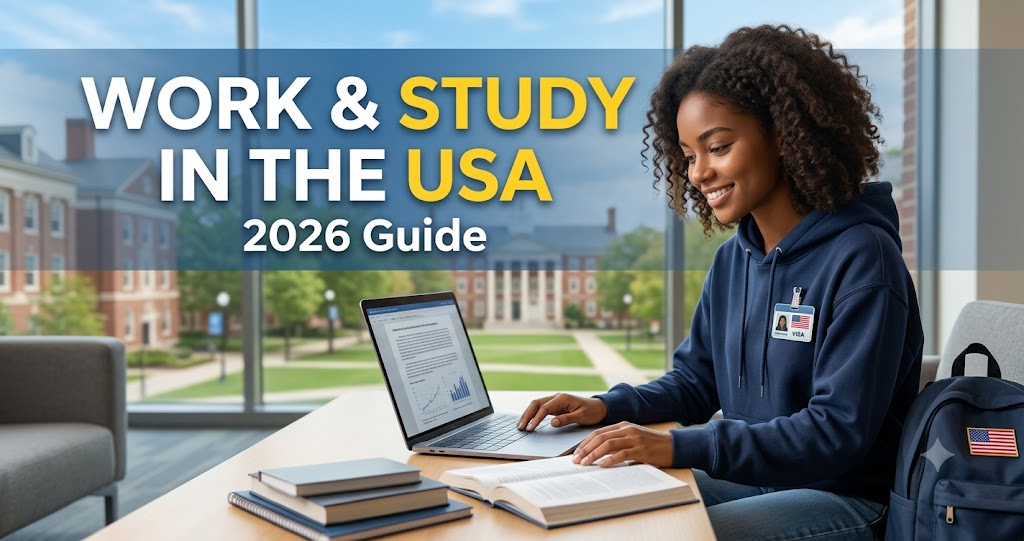
Study and work in the USA in 2026 with this guide to international student scholarships, F-1 visas, tuition funding, OPT, STEM OPT and career pathways.
If your goal is to study and work in the USA in 2026, choosing a university is only one part of the process. International students also need to consider scholarships, tuition and living costs, student visa requirements, permitted employment, practical training opportunities and what happens after graduation.
The United States offers several education routes for international students, including undergraduate degrees, graduate programs, professional education, vocational programs and approved exchange programs. The appropriate visa depends on the type of program and the circumstances of the student. The U.S. Department of State identifies F and M visas for academic and vocational study, while J visas cover approved exchange programs. Students generally need to be accepted by an appropriate school or program sponsor before applying for the relevant visa.
At the same time, international students should not assume that a U.S. student visa automatically provides unrestricted permission to work. Employment is regulated, and F-1 students must follow the applicable rules for on-campus employment, Curricular Practical Training (CPT), Optional Practical Training (OPT) and, where eligible, the STEM OPT extension.
This guide explains how the pieces fit together—from finding scholarships and choosing an affordable program to maintaining legal student status and planning a career after graduation.
Table of Contents
- Why Study and Work in the USA in 2026?
- How Much Does It Cost to Study in the USA?
- Scholarships and Financial Aid for International Students
- Choosing an Affordable U.S. University
- Understanding U.S. Student Visa Options
- The F-1 Student Visa
- The M-1 Student Visa
- The J-1 Exchange Visitor Route
- How the U.S. Student Visa Process Works
- Working While Studying in the USA
- CPT and Internship Opportunities
- OPT After Graduation
- STEM OPT and High-Skilled Career Pathways
- From OPT to Employer-Sponsored Employment
- High-Value Career Fields for International Graduates
- How to Build a Career While Studying
- Special Considerations for Nigerian Students
- Common Mistakes International Students Should Avoid
- A Practical 2026 Study-to-Career Roadmap
- Frequently Asked Questions
- Final Takeaway
- Author Box
1. Why Study and Work in the USA in 2026?
For many international students, studying in the United States is not simply about earning a degree. It can also provide access to internships, professional networks, research opportunities and practical training connected to an academic program.
The U.S. higher-education system includes universities, colleges, graduate schools, community colleges and specialized institutions. EducationUSA, the U.S. Department of State’s international education advising network, provides information on researching institutions, financing education, applying to schools, obtaining student visas and preparing for departure.
The important distinction is that education and employment are separate legal considerations.
A student should therefore ask:
- What degree or credential am I pursuing?
- How much will tuition and living expenses cost?
- What scholarships are available?
- Is the institution authorized to enroll international students?
- Which visa category applies?
- What employment options are legally available?
- Does my program qualify for practical training?
- Could the degree support my intended career after graduation?
Answering these questions before paying application or tuition costs can make the process considerably more manageable.
2. How Much Does It Cost to Study in the USA?
The cost of studying in America varies significantly by institution, location, degree level and lifestyle.
Your education budget should include more than tuition.
Consider:
- Tuition
- University fees
- Accommodation
- Food
- Health insurance
- Books and supplies
- Transportation
- Visa-related expenses
- SEVIS-related costs where applicable
- Personal expenses
- Emergency funds
EducationUSA advises international students to evaluate tuition, fees and living expenses when developing their financial plan. It also notes that costs vary considerably between locations in the United States.
For graduate students, for example, the financial picture can be very different between a major metropolitan area and a smaller university town.
Think about total cost—not just tuition
A university advertising lower tuition may not necessarily produce the lowest overall cost if accommodation and transportation are substantially more expensive.
A useful calculation is:
Estimated annual cost = tuition + mandatory fees + housing + food + insurance + transportation + personal expenses − confirmed scholarships/grants
This gives prospective students a more realistic picture of the financial commitment.
3. Scholarships and Financial Aid for International Students
Scholarships are one of the most important parts of an international student’s U.S. education strategy.
However, applicants should avoid websites claiming that every international student can obtain a “fully funded scholarship” simply by submitting a basic form.
Scholarship availability differs by institution, degree level, academic record, nationality, field of study and funding source.
EducationUSA maintains a searchable financial-aid database containing opportunities offered by U.S. institutions and other organizations. Its database includes academic scholarships, tuition-related awards and other forms of assistance for international students.
Official EducationUSA financial-aid database
Types of funding to investigate
Merit scholarships
These are commonly linked to academic achievement, leadership, extracurricular accomplishments or other qualifications.
Need-based financial aid
Some institutions provide financial assistance based on demonstrated financial circumstances, although eligibility rules vary significantly.
Graduate assistantships
Graduate students may encounter teaching assistantships, research assistantships or other university-funded positions.
Tuition waivers and discounts
Some universities offer partial tuition reductions or nonresident tuition benefits to eligible international students.
External scholarships
Government agencies, foundations, international organizations and other institutions may provide scholarships for students studying abroad.
The key is to investigate funding before applying, because scholarship deadlines do not always match the general university admission deadline.
4. Choosing an Affordable U.S. University
The phrase “study in America” can create the impression that only highly recognizable universities are worth considering.
That approach can make the financial planning process unnecessarily difficult.
Instead, compare schools using several variables:
| Factor | Why it matters |
|---|---|
| Tuition | Determines the basic education cost |
| Scholarships | Can reduce tuition or total expenses |
| Location | Affects housing and everyday spending |
| Program quality | Relevant to academic and career goals |
| Internship access | Can affect practical experience |
| Career services | Can support job searches |
| International student support | Helps with immigration and academic issues |
| STEM classification | Important for students considering STEM OPT |
| Employer connections | May provide networking opportunities |
| Accreditation/recognition | Important for academic and professional planning |
Students should also verify that a school is authorized to enroll students under the appropriate F-1 or M-1 system where applicable.
DHS provides a searchable database of SEVP-certified schools.
DHS Study in the States school search
5. Understanding U.S. Student Visa Options
The three categories most relevant to international education are F-1, M-1 and J-1.
They should not be treated as interchangeable.
| Visa category | General purpose |
|---|---|
| F-1 | Academic study |
| M-1 | Vocational/nonacademic study |
| J-1 | Approved exchange programs |
The U.S. Department of State specifically identifies F and M visas for academic and vocational studies and J visas for exchange programs.
Your institution or program sponsor will generally provide the documentation needed for the relevant immigration process.
6. The F-1 Student Visa
The F-1 visa is the primary U.S. student visa for international students pursuing academic education.
It can apply to students attending eligible colleges, universities and other academic institutions.
Before applying, an international student normally needs admission to a school authorized to enroll F-1 students.
The DHS student lifecycle explains that an accepted student receives a Form I-20 from the school’s designated school official after the SEVIS record is created. The student then uses the required documentation when applying for the student visa.
Students should understand that maintaining F-1 status is an ongoing responsibility.
This includes following enrollment requirements and employment restrictions.
7. The M-1 Student Visa
The M-1 visa is intended primarily for vocational or other recognized nonacademic study.
Its rules differ from F-1 status, particularly regarding employment and practical training.
Students considering technical, vocational or career-focused education should confirm whether their intended program falls under F-1 or M-1 classification before planning their immigration strategy.
DHS explains that F-1 students generally have broader practical-training options than M-1 students, while M-1 students have specific practical-training limitations.
8. The J-1 Exchange Visitor Route
The J-1 visa covers approved exchange visitor programs.
It can apply to certain students, scholars and participants in recognized exchange programs.
The important point is that J-1 is not simply another version of F-1.
Program-specific rules apply, including requirements associated with the exchange program and, in some circumstances, restrictions affecting future immigration options.
Applicants should therefore review their DS-2019 documentation and program conditions carefully.
9. How the U.S. Student Visa Process Works
A typical academic route involves several stages:
Step 1: Research programs
Compare institutions, degree programs, tuition, scholarships, location and career services.
Step 2: Apply for admission
Submit the university’s required academic and supporting documents.
Step 3: Receive admission
If accepted and eligible, the school provides the appropriate immigration documentation.
For F-1 students, this generally includes Form I-20.
Step 4: Complete required student-visa procedures
Applicants should follow the Department of State’s current instructions, including applicable fees and documentation.
The current State Department schedule lists a $185 nonimmigrant visa application processing fee for F and M categories, although applicants should verify the fee before paying because government fees can change.
Step 5: Prepare for the visa interview or adjudication process
Applicants should understand their academic program, funding plan and intended study clearly.
Step 6: Prepare for travel
Once authorized to travel, students should carry their required immigration and school documents and follow the entry requirements.
U.S. Department of State — Student Visa information
10. Working While Studying in the USA
One of the biggest misconceptions about studying in the United States is that an F-1 visa provides unrestricted permission to work.
It does not.
DHS states that F-1 students may work only under authorized circumstances, including certain on-campus employment and authorized practical-training categories.
Unauthorized employment can create serious immigration problems.
Students should therefore speak with their designated school official before accepting employment if they are uncertain about whether the job is permitted.
On-campus employment
Eligible F-1 students may generally work on campus subject to applicable restrictions.
Examples can include:
- University library roles
- Campus administrative positions
- Student services
- Dining facilities
- Research-related roles
- Campus support positions
DHS identifies on-campus employment as one category of F-1 employment.
The income should be viewed as supplementary financial support rather than a substitute for a credible education funding plan.
11. CPT and Internship Opportunities
Curricular Practical Training (CPT) can allow eligible F-1 students to undertake practical training that is directly connected to their academic curriculum.
This can include certain internships, cooperative education programs and practicums.
DHS explains that CPT must be tied to the student’s curriculum and involves an employer participating through the appropriate school arrangements.
This makes CPT particularly relevant for students who want to graduate with practical experience rather than relying exclusively on classroom credentials.
A practical strategy
When choosing a program, investigate:
- Whether internships are built into the curriculum
- Whether employers regularly recruit students
- Whether the program has cooperative education arrangements
- Whether career services assists international students
- Whether the academic department has employer partnerships
A degree with strong practical exposure can help a student develop professional experience before graduation.
12. OPT After Graduation
Optional Practical Training (OPT) is one of the most important career pathways for eligible F-1 students.
OPT allows qualifying students to obtain temporary employment directly related to their area of study.
The U.S. Department of State describes OPT as temporary employment directly related to an eligible F-1 student’s field of study, with USCIS authorization required.
DHS’s practical-training guidance states that post-completion OPT can provide up to 12 months of authorization, subject to the applicable rules.
This is why career planning should begin well before graduation.
A student should not wait until the final week of a degree program to begin thinking about employment.
13. STEM OPT and High-Skilled Career Pathways
Students completing qualifying degrees in science, technology, engineering and mathematics may have access to the 24-month STEM OPT extension, subject to the applicable requirements.
That can provide additional time for qualifying professional experience after the initial OPT period.
USCIS guidance confirms that qualifying F-1 students may be eligible for a 24-month STEM OPT extension. STEM OPT employment involves additional requirements, including an eligible employer and training-plan obligations.
For example, STEM-related programs can include areas such as:
- Computer science
- Data science
- Engineering
- Information technology
- Certain mathematics disciplines
- Biotechnology and related fields
- Other qualifying programs on the DHS STEM list
Students should verify their specific degree program, rather than assuming that every technology or science degree automatically qualifies.
USCIS — Optional Practical Training and STEM OPT information
14. From OPT to Employer-Sponsored Employment
OPT is temporary. It should therefore be considered part of a broader career strategy rather than an automatic route to permanent employment.
Some international graduates pursue employer-sponsored employment after developing U.S. work experience.
Depending on the individual circumstances, potential employment-based immigration categories can include options such as H-1B or other employer-sponsored classifications.
Eligibility depends on the worker, position, employer and applicable immigration rules.
USCIS identifies H-1B among the principal temporary employment categories used for qualifying specialty occupations.
There is no guarantee that an employer will sponsor a graduate.
That is why students should research employers before graduation, including:
- Whether they hire international graduates
- Whether they have sponsored workers previously
- Whether the position fits the graduate’s field
- Whether the employer participates in relevant employment-verification programs
- Whether the company recruits directly from universities
15. High-Value Career Fields for International Graduates
The phrase “high-paying career” should not be used as a guarantee of a particular salary.
Compensation varies by location, experience, employer, degree and specialization.
However, students researching career-oriented degrees often examine fields such as:
Technology
Potential areas include:
- Software engineering
- Cloud computing
- Cybersecurity
- Data analytics
- Artificial intelligence
- Information systems
Engineering
Potential areas include:
- Electrical engineering
- Mechanical engineering
- Civil engineering
- Industrial engineering
- Computer engineering
Finance and business
Potential career areas include:
- Financial analysis
- Risk management
- Accounting
- Business analytics
- Management consulting
- Corporate finance
Healthcare
Depending on licensing requirements, international graduates may pursue areas such as:
- Public health
- Health administration
- Healthcare analytics
- Biomedical research
- Nursing and other regulated professions
Research and academia
Graduate students can also pursue:
- University research
- Laboratory work
- Research organizations
- Doctoral programs
- Academic careers
Students should investigate professional licensing requirements where applicable. A U.S. degree does not automatically grant authorization to practice every regulated profession.
16. How to Build a Career While Studying
A degree alone is rarely the complete career strategy.
International students can use their time in the United States to build:
A professional resume
Keep a record of projects, research, internships, certifications and measurable achievements.
A LinkedIn profile
Present academic and professional experience clearly and professionally.
A portfolio
Students in technology, design, marketing, analytics and other project-based fields can demonstrate their skills through appropriate portfolios.
Professional relationships
Attend:
- Career fairs
- Employer information sessions
- Alumni events
- Academic conferences
- Professional association meetings
- University networking events
Faculty relationships
Professors and academic advisers can sometimes provide information about research opportunities, internships and graduate-level career development.
Career services
Before choosing a university, examine whether its career center actively supports international students.
17. Special Considerations for Nigerian Students
Nigerian applicants need to pay particularly close attention to current U.S. visa policy.
As of January 1, 2026, the U.S. Department of State states that visa issuance for nationals of Nigeria is subject to a partial suspension covering F, M and J visas, with specified exceptions. Because this policy directly affects prospective Nigerian students, applicants should review the current State Department announcement and any subsequent updates before making nonrefundable plans.
This is a critical distinction:
Admission to a U.S. university and issuance of a U.S. visa are separate decisions.
A student can receive an academic admission offer while still facing visa-related restrictions or requirements.
Nigerian applicants should therefore verify the latest information through:
U.S. Department of State — Nigeria visa information
and:
U.S. Department of State — current visa announcements
Students should also be aware that the State Department currently includes F-1, M-1 and J-1 applicants within its online-presence review and vetting procedures.
Policies can change, so applicants should rely on current government instructions rather than old social-media posts or outdated visa guides.
18. Common Mistakes International Students Should Avoid
Mistake 1: Choosing a university based only on its name
A famous institution may not necessarily be the right financial or academic fit.
Mistake 2: Assuming every scholarship is fully funded
Read the award conditions carefully.
Some scholarships cover tuition only, while others may cover a percentage of tuition or provide a fixed amount.
EducationUSA specifically notes that scholarship awards may cover only part of overall educational and living costs.
Mistake 3: Treating part-time work as the primary funding plan
Students should establish adequate funding before beginning their studies.
F-1 employment rules matter. Unauthorized employment can have immigration consequences.
Mistake 5: Waiting until graduation to search for jobs
Career planning should begin during the academic program.
Mistake 6: Assuming every STEM degree qualifies for STEM OPT
Check the specific degree and the current DHS STEM-designated-degree requirements.
Mistake 7: Paying an unverified immigration agent
Students should use official government websites for immigration rules and verify what a consultant is actually authorized to provide.
Mistake 8: Using outdated information
Visa rules, fees, processing procedures and government policies can change.
Always verify current information before submitting an application or making a financial commitment.
19. A Practical 2026 Study-to-Career Roadmap
A useful approach is to divide the process into stages.
Stage 1: Career research
Choose a field based on:
- Academic interests
- Existing qualifications
- Career demand
- Professional licensing requirements
- Potential internship opportunities
- Long-term career objectives
Stage 2: University research
Create a comparison spreadsheet covering:
- Tuition
- Scholarships
- Location
- Housing
- Program length
- Internship availability
- Career services
- International student support
- STEM status where relevant
Stage 3: Funding strategy
Calculate the total expected cost and identify:
- Scholarships
- Grants
- Assistantships
- Personal funding
- Family support
- Permitted financial resources
Do not rely on unconfirmed scholarship promises.
Stage 4: Admission
Apply to institutions that fit your academic and financial profile.
Stage 5: Immigration planning
Once accepted, follow the school’s instructions for the appropriate student or exchange visitor documentation.
Stage 6: Career preparation
Start developing professional skills before graduation.
Stage 7: Practical training
If eligible, investigate CPT and OPT with your designated school official.
Stage 8: Post-graduation planning
Students approaching graduation should understand their available immigration and employment options before their authorized period ends.
20. Frequently Asked Questions
Can international students study and work in the USA in 2026?
Yes, eligible international students may be able to work under specific authorization rules. F-1 students can have certain on-campus employment and practical-training options, but a student visa does not provide unrestricted work authorization.
What is the main student visa for U.S. universities?
The F-1 visa is generally used for academic study. M-1 applies to qualifying vocational study, while J-1 is used for approved exchange programs.
Can I work after graduating from a U.S. university?
Eligible F-1 graduates may apply for OPT, which provides temporary practical training directly related to their field of study.
How long is standard post-completion OPT?
Qualifying F-1 students can generally receive up to 12 months of OPT, subject to applicable requirements.
Can STEM graduates receive additional OPT time?
Eligible graduates whose degrees and employment meet the applicable requirements may qualify for a 24-month STEM OPT extension.
Are scholarships available for international students?
Yes. U.S. institutions and other organizations offer scholarships and financial-aid opportunities, but eligibility and award amounts vary. EducationUSA maintains a searchable database of opportunities.
Can I pay for my entire U.S. education by working part-time?
Students should not assume this is realistic or permitted. Employment is regulated, and students should have an appropriate financial plan before beginning their program.
Can a U.S. degree lead to employer sponsorship?
It can be part of a longer-term professional pathway, but graduation does not guarantee employer sponsorship. Eligibility depends on the employment category, student, position, employer and applicable immigration rules.
21. Final Takeaway
The path to study and work in the USA in 2026 is best approached as a connected education, finance, immigration and career-planning process.
Start by identifying the degree and career you want. Then compare universities based on total cost, scholarship opportunities, academic quality, location, internship access and career support.
After admission, understand the student visa requirements and maintain lawful status throughout the program. For F-1 students, authorized employment opportunities can include on-campus employment, CPT and OPT, while qualifying STEM graduates may have access to the additional STEM OPT period.
Most importantly, do not treat a student visa as a guaranteed immigration pathway to permanent employment. Build your career plan around education, skills, professional experience and compliance with U.S. immigration rules.
For authoritative immigration information, use the U.S. Department of State, USCIS and DHS rather than relying exclusively on third-party blogs or social-media claims.
U.S. Department of State — Study & Exchange Visas
USCIS — Students and Employment
EducationUSA — Official U.S. higher-education advising resource
Dynamo Gills
Writer & Researcher at Jobs Biodynasty
Dynamo Gills writes about international education, scholarships, immigration pathways, employment opportunities and career development. His work focuses on practical, research-based information designed to help international students and professionals make informed decisions about studying and working abroad.

 Dynamo Gills