 Dynamo Gills
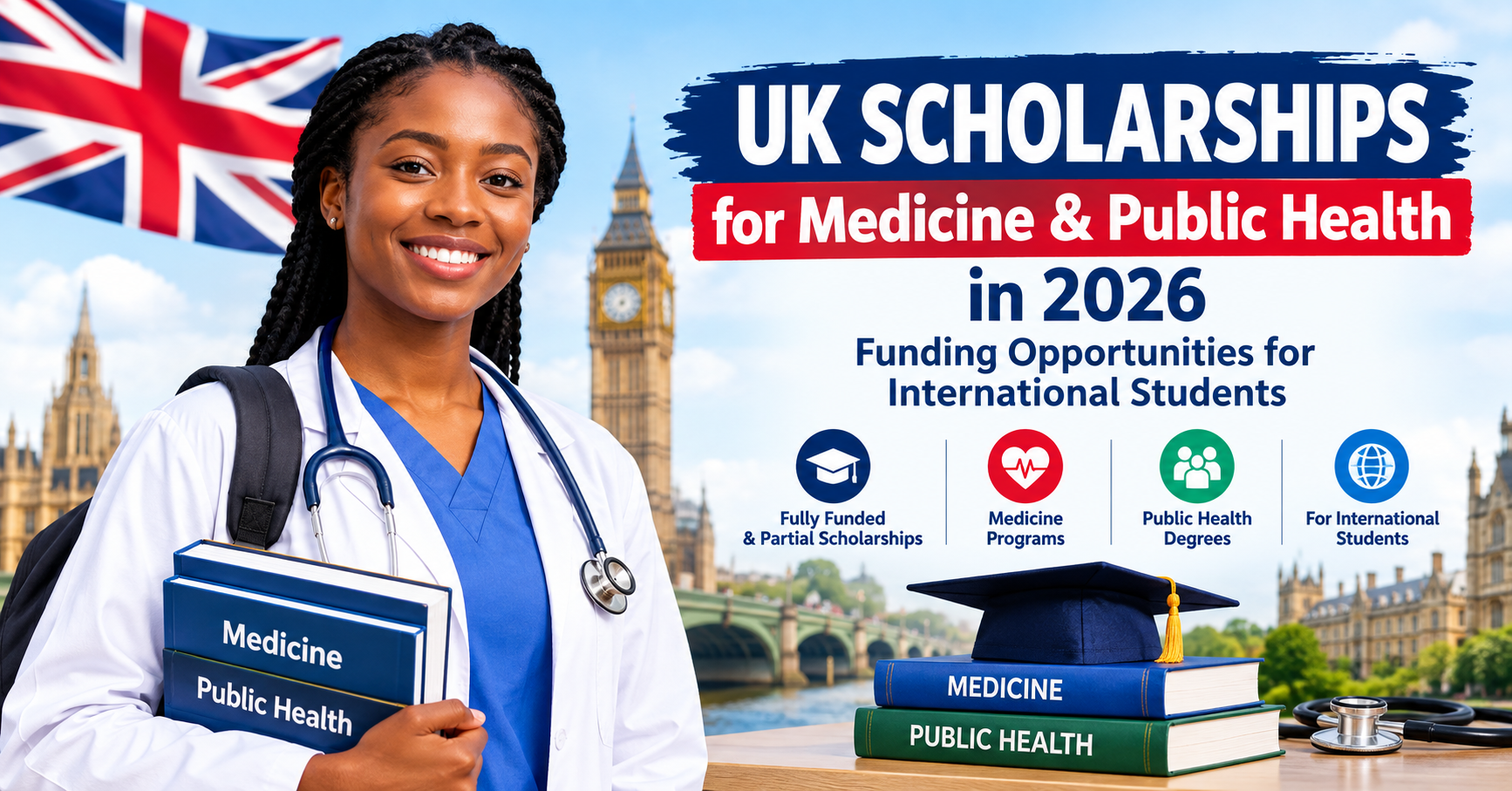
UK scholarships for medicine and public health can help international students reduce the cost of postgraduate education in areas such as clinical research, epidemiology, global health, health policy, public health and healthcare leadership.
The United Kingdom has several universities with internationally recognised medical and public-health programmes, but international tuition fees can be substantial. Scholarship opportunities therefore deserve careful research, particularly for students from low- and middle-income countries.
For 2026/27 entry, funding is available through several routes, including UK government-backed programmes, university scholarships, Commonwealth awards, GREAT Scholarships and specialist awards offered by institutions such as the London School of Hygiene & Tropical Medicine (LSHTM), Imperial College London and University College London (UCL).
One important point is that medical school funding and public-health postgraduate funding are not the same thing. Many of the scholarships discussed in this guide are aimed at master’s or research programmes rather than undergraduate MBBS/MBChB degrees. Applicants should therefore check the precise course and scholarship eligibility requirements before applying.
2026 timing note: Some scholarships for programmes beginning in September/October 2026 had application deadlines earlier in 2026. This guide identifies those opportunities and explains their eligibility so prospective applicants can also prepare for subsequent scholarship cycles.
Table of Contents
- Why Study Medicine or Public Health in the UK?
- Types of UK Scholarships Available
- Commonwealth Scholarships for Public Health
- Chevening Scholarships
- GREAT Scholarships
- LSHTM Scholarships for International Students
- Imperial College London Scholarships
- UCL Scholarships for Public Health
- Oxford Clarendon Scholarships
- Cambridge Trust Scholarships
- Scholarships for Medical and Health-Related Research
- Who Can Apply?
- Documents You May Need
- How to Find Suitable Scholarships
- How to Improve Your Scholarship Application
- Common Mistakes to Avoid
- Can International Students Get Fully Funded Medical Scholarships?
- Funding Beyond Tuition Fees
- UK Student Visa and Financial Planning
- Frequently Asked Questions
- Final Thoughts
Why Study Medicine or Public Health in the UK?
The UK has a large higher-education and research sector covering medicine, biomedical sciences, epidemiology, health economics, infectious diseases, global health and health policy.
For international students, studying in the UK can provide access to academic training, research facilities and professional networks. Public-health programmes can also be relevant to applicants working in ministries of health, hospitals, NGOs, international development organisations, research institutions and community health programmes.
Possible areas of study include:
- Medicine
- Public Health
- Global Health
- Epidemiology
- Tropical Medicine
- Health Economics
- Health Policy
- Health Data Science
- Clinical Research
- Infectious Disease Research
- Population Health
- Healthcare Management
- Biomedical Sciences
- Medical Statistics
- Pharmaceutical Sciences
The funding landscape is particularly strong at postgraduate level. For example, the Commonwealth Shared Scholarship programme’s 2026 approved courses included public health, global health policy, clinical research, respiratory medicine, medical statistics, infectious diseases and population health programmes at universities across the UK.
Types of UK Scholarships Available
International students should understand the difference between the main types of funding.
Fully funded scholarships
A fully funded scholarship may cover several components, such as:
- Full tuition fees
- Living allowance
- Airfare
- Visa-related costs
- Health-related immigration costs
- Study or research allowances
However, “fully funded” does not necessarily mean every personal expense will be covered.
Full tuition scholarships
These awards cover tuition but may leave the student responsible for accommodation, food, transportation and other living expenses.
Partial tuition scholarships
A scholarship may deduct a fixed amount from international tuition fees. For example, some GREAT Scholarships provide £10,000 toward tuition, while the Imperial College London GREAT award for 2026 is worth £15,000.
University bursaries and studentships
These are often attached to a particular course, department, faculty or research area.
Commonwealth Scholarships for Public Health
The Commonwealth Scholarship Commission (CSC) provides several scholarship programmes for eligible applicants from Commonwealth countries.
For public-health applicants, the Commonwealth Shared Scholarships are particularly relevant because the 2026 approved-course list includes numerous health-related master’s degrees.
Examples include:
- MSc Public Health and Health Promotion at Bangor University
- MPH Public Health at Newcastle University
- MPH Public Health at Queen’s University Belfast
- MPH Public Health at the University of Glasgow
- MPH Public Health at the University of Leeds
- MPH Public Health at the University of Warwick
- MPH Public Health (International) at Liverpool School of Tropical Medicine
- MPhil Population Health Sciences at Cambridge
- MSc Global Health Science and Epidemiology at Oxford
- MSc Global Health and Development at UCL
- MSc Respiratory Medicine at Birmingham
- MSc Emerging Infections and Pandemics at Liverpool.
For the 2026/27 cycle, Commonwealth Shared Scholarships were intended for master’s study beginning in September/October 2026. The CSC states that candidates generally needed to be citizens or refugees of an eligible Commonwealth country, permanently resident in an eligible Commonwealth country, hold the required first degree and demonstrate that they could not otherwise afford the UK study.
The 2026/27 application round is now closed, but the programme is important for applicants planning future Commonwealth scholarship cycles.
Commonwealth Scholarship Commission – Scholarships and Fellowships
Chevening Scholarships
The Chevening Scholarship is one of the UK’s major government-funded scholarship programmes for international students pursuing eligible one-year master’s degrees.
It can be particularly relevant to public-health professionals who already have professional experience and want to develop leadership skills in areas such as:
- Health policy
- Global health
- Public administration
- Healthcare management
- Development
- International health systems
According to Chevening’s eligibility requirements, applicants must be citizens of a Chevening-eligible country or territory, have at least two years of eligible work experience, hold an undergraduate degree that qualifies them for a UK master’s programme and apply to three eligible UK university courses. They must also commit to returning to their country of award for at least two years after the scholarship ends.
Chevening applicants should therefore consider not only the academic relevance of their proposed degree but also how their professional experience and future plans connect to their home country’s development.
The UK government’s international postgraduate scholarship guidance also identifies Chevening and Commonwealth scholarships as major routes for international students.
Chevening – Eligibility Criteria
GREAT Scholarships
The GREAT Scholarships programme is another important source of UK postgraduate funding.
For the 2026/27 academic year, more than 140 scholarships were available through more than 60 UK universities. Awards are generally worth £10,000 toward tuition fees, although individual university awards can differ.
GREAT Scholarships are available to students from a defined list of countries, including Nigeria, Ghana, Kenya, India, Pakistan, Egypt and several others.
GREAT Scholarships and medicine
This programme is especially relevant to health-related applicants because participating universities include institutions with medicine and public-health programmes.
For example, Imperial College London’s 2026 GREAT Scholarship is worth £15,000 toward tuition fees and is available to eligible applicants from France, Egypt, Ghana and Nigeria studying eligible one-year full-time master’s programmes. Imperial’s eligible academic areas include the School of Public Health.
UCL also offered GREAT Scholarships worth £10,000 for eligible Nigerian and Pakistani students undertaking full-time postgraduate taught master’s programmes for 2026/27.
Brunel University London’s 2026 GREAT Scholarship included MSc Public Health and Health Promotion among its eligible programmes for students from Nigeria, China and Vietnam.
LSHTM Scholarships for International Students
The London School of Hygiene & Tropical Medicine (LSHTM) is particularly relevant to students searching for UK scholarships for medicine and public health.
Its programmes cover areas such as:
- Public health
- Epidemiology
- Tropical medicine
- Infectious diseases
- Global health
- Health policy
- Health data
- Disease control
LSHTM Fund Scholarship
For 2026/27, LSHTM offered one LSHTM Fund Scholarship for an applicant intending to study a one-year, full-time London-based MSc.
The award includes:
- Overseas tuition fees
- Mandatory field-trip fees
- A tax-free £22,000 living allowance.
The scholarship is aimed at an excellent candidate who would otherwise be unable to take up their place because of financial constraints.
GSK Scholarships for Future Health Leaders
LSHTM also offered three GSK Scholarships for Future Health Leaders for 2026/27.
Each scholarship covered:
- Tuition fees
- Mandatory field-trip fees
- A tax-free £22,000 living allowance.
The programme was designed for applicants from sub-Saharan Africa who intended to return to the region after completing their MSc. Applicants needed an eligible first degree and an offer for an eligible LSHTM London-based intensive MSc.
The scholarship also placed emphasis on applicants who could make significant contributions to public health or health-related research in Africa.
Imperial College London Scholarships
Imperial College London has several funding opportunities relevant to medicine, public health and health-related research.
The university’s School of Public Health offers scholarships for postgraduate programmes such as:
- Master of Public Health
- MSc Epidemiology
- MSc Health Data Analytics and Machine Learning
For the 2026 entry cycle, Imperial stated that its School of Public Health scholarships could be available to UK, EU and overseas candidates. For on-campus programmes, some awards covered tuition at the home-student rate, meaning overseas recipients could still have a remaining tuition balance. The School also offered a full-fee scholarship for its online Master of Public Health programme.
This illustrates an important distinction for international applicants: a scholarship can be substantial without being fully funded.
Applicants should therefore calculate the remaining tuition balance and living expenses before accepting an award.
Imperial also advertised a £10,000 scholarship contribution for its MRes in Epidemiology, Evolution and Control of Infectious Diseases for October 2026 entry.
Imperial College London – School of Public Health Scholarships
UCL Scholarships for Public Health
University College London has a broad selection of funding opportunities for students interested in population health, global health and public health.
Its Institute for Global Health lists funding options including:
- Institute for Global Health Postgraduate Bursaries
- African Graduate Scholarship
- GREAT Scholarship
- Commonwealth Shared Scholarship Scheme
- Office of Health Economics Fellowship
- Other external funding opportunities.
African Graduate Scholarship
For the MSc Global Health and Development, UCL listed an African Graduate Scholarship worth £40,670 for one year of full-time study for the 2026/27 academic year. The scholarship was assessed using academic merit and financial need.
Institute for Global Health Postgraduate Bursaries
UCL also listed £2,000 postgraduate bursaries for eligible MSc applicants in areas including:
- Global Health and Development
- Health Economics and Decision Science
- Applied Infectious Diseases Epidemiology
- Global Mental Health.
Dental Public Health scholarship
UCL’s Aubrey Sheiham Scholarship for overseas students undertaking the MSc Dental Public Health was worth £12,000 for one year. The award was intended for full-time overseas students in financial need, although recipients were expected to cover remaining tuition and living costs.
Oxford Clarendon Scholarships
The Clarendon Scholarship at the University of Oxford is another major funding route for international postgraduate students.
Oxford states that Clarendon scholarships are open across subject areas and to candidates applying for eligible new master’s and DPhil programmes by the relevant December or January admissions deadline.
For full-time scholars, Clarendon provides:
- Full course-fee coverage
- An annual living-cost grant
The scholarship has no nationality or ordinary-residence restriction.
This makes Clarendon potentially relevant to international applicants pursuing health-related graduate programmes at Oxford, provided their particular course qualifies.
Importantly, applicants do not submit a separate Clarendon scholarship application. They must apply for their Oxford graduate course by the relevant funding deadline to be automatically considered.
University of Oxford – Clarendon Scholarships
Cambridge Trust Scholarships
The Cambridge Trust provides funding opportunities for international students at the University of Cambridge.
The Cambridge International Scholarship is available to applicants from countries outside the UK and Ireland who are highly ranked by their prospective departments.
The award can cover:
- International tuition fees
- Annual maintenance
- Student visa costs
- Immigration Health Surcharge
- Additional benefits.
The Cambridge Trust states that applicants need to submit their admission application by the relevant funding deadline and indicate that they wish to be considered for funding. A conditional offer is required for Trust funding consideration.
For health-focused applicants, prospective students should search Cambridge’s current postgraduate course directory and scholarship database to identify programmes and awards relevant to medicine, population health or biomedical research.
Cambridge Trust – Find a Scholarship
International students interested in medicine should not search only for scholarships containing the word “medicine.”
Many valuable awards are attached to related disciplines, including:
- Epidemiology
- Biomedical research
- Medical statistics
- Health data science
- Infectious diseases
- Global health
- Population health
- Tropical medicine
- Clinical research
- Pharmaceutical science
- Health economics
The Commonwealth Shared Scholarship list demonstrates this broad funding landscape, with approved health programmes ranging from respiratory medicine and clinical research to global health and epidemiology.
This approach can significantly expand the number of relevant opportunities an applicant finds.
Who Can Apply?
Eligibility depends on the individual scholarship, but international applicants may commonly need:
- An eligible nationality
- A relevant undergraduate degree
- Strong academic results
- Admission or an offer from a UK university
- Evidence of English-language proficiency where required
- Relevant professional experience for certain awards
- Leadership or community involvement for some scholarships
- A strong personal statement
- Academic or professional references
For example, Chevening requires at least two years of eligible work experience, while some university scholarships focus primarily on academic achievement and financial need.
Documents You May Need
Prepare your scholarship documents before application deadlines.
Common requirements include:
Academic documents
- Degree certificate
- Academic transcripts
- Professional qualifications
- Research publications, where applicable
Identity documents
- Passport
- National identification document where required
English-language evidence
- IELTS, TOEFL or another accepted qualification where required
Professional documents
- CV
- Employment history
- Professional registration where relevant
Application documents
- Personal statement
- Study plan
- Research proposal for research programmes
- Scholarship essays
- Academic references
- Professional references
Applicants for medical programmes may also need professional registration or evidence of clinical qualifications, depending on the course.
How to Find Suitable Scholarships
A successful funding search should begin with the course, not just the scholarship.
Start by identifying several UK programmes that match your academic and professional background.
Then check:
- International tuition fee
- Course duration
- Scholarship eligibility
- Scholarship value
- Application deadline
- Whether admission is required first
- Whether the scholarship covers living expenses
- Whether the programme is full-time or part-time
- Whether the scholarship applies to overseas students
Use official scholarship databases and university funding pages rather than relying exclusively on social-media posts or third-party scholarship websites.
The UK government’s postgraduate scholarship guidance is a useful starting point for identifying major government-backed options.
How to Improve Your Scholarship Application
A strong scholarship application should explain more than why you want to study in the UK.
It should establish a logical connection between your:
Past → Proposed study → Future impact
For example:
A public-health professional may explain how their previous experience exposed a specific healthcare challenge, how an MSc in epidemiology or global health will provide the technical skills needed to address that challenge, and how they intend to apply those skills after returning home.
Evidence is important.
Instead of simply writing:
“I am passionate about public health.”
Explain what you have actually done.
Examples could include:
- Working on disease-prevention programmes
- Supporting vaccination campaigns
- Conducting community health research
- Working in a hospital
- Managing health projects
- Publishing research
- Supporting vulnerable populations
- Developing health education programmes
The strongest applications usually demonstrate a credible connection between education, experience and future objectives.
Common Mistakes to Avoid
Applying without checking nationality requirements
Some scholarships are restricted to specific countries.
Assuming every scholarship is fully funded
A £10,000 or £15,000 award may cover only part of an international student’s tuition.
Ignoring the admission deadline
Some scholarships require applicants to hold an offer before funding can be considered.
Applying for the wrong academic level
A scholarship for a one-year master’s degree will not normally fund an undergraduate medical degree.
Waiting until the final day
University scholarship deadlines can differ considerably from general university admission deadlines.
Using outdated scholarship information
Funding programmes change frequently. Always verify the current scholarship year, eligibility criteria and closing date on the official provider’s website.
Can International Students Get Fully Funded Medical Scholarships?
Yes, fully funded opportunities exist for international students in health-related fields, but fully funded undergraduate medicine scholarships are considerably more limited than postgraduate public-health and research funding.
Many prominent UK scholarships concentrate on master’s, doctoral or research-level study.
For example, the Commonwealth Shared Scholarship programme is specifically for master’s courses, while Clarendon supports eligible master’s and DPhil study.
Students seeking undergraduate medicine should therefore search specifically for:
- International undergraduate scholarships
- Medical school bursaries
- University-specific awards
- Country-specific scholarships
- External charitable funding
- Government sponsorship programmes
Students seeking postgraduate medicine or public health have a broader scholarship landscape.
Funding Beyond Tuition Fees
Tuition is only one part of the cost of studying in the UK.
International students should budget for:
- Accommodation
- Food
- Transportation
- Books and equipment
- Visa costs
- Immigration-related charges
- Health-related immigration costs where applicable
- Flights
- Personal expenses
A scholarship that covers tuition but not living costs can still leave a substantial financial requirement.
For example, Imperial’s School of Public Health explicitly notes that some overseas scholarship recipients may need to pay the difference between the home-rate scholarship contribution and the overseas tuition fee.
By contrast, some major awards such as Cambridge International Scholarships and Oxford Clarendon provide both tuition-related and living-cost support.
UK Student Visa and Financial Planning
Receiving a scholarship does not automatically mean that every UK student-visa requirement disappears.
Students should check the current UK government immigration requirements before submitting a visa application.
The scholarship award letter can be important evidence when determining how much funding is already covered, but applicants should carefully review their individual circumstances and the current requirements.
GOV.UK – Student Visa Guidance
Frequently Asked Questions
What are the best UK scholarships for public health international students?
Relevant options include Commonwealth Scholarships, Chevening, GREAT Scholarships and university-specific awards at institutions such as LSHTM, Imperial College London, UCL, Oxford and Cambridge. Eligibility varies by nationality, programme and academic level.
Can Nigerian students apply for UK medicine and public-health scholarships?
Yes. Nigerian applicants are eligible for a number of UK scholarship programmes, depending on the specific award. Nigeria is included among the countries eligible for the 2026/27 GREAT Scholarship programme, and Imperial and UCL are among participating institutions.
Is LSHTM suitable for public-health scholarship applicants?
Yes. LSHTM offers a range of public-health and global-health programmes and has dedicated scholarship opportunities. Its 2026/27 funding included the LSHTM Fund Scholarship and GSK Scholarships for Future Health Leaders.
Does Chevening fund medicine?
Chevening funds eligible one-year UK master’s programmes rather than undergraduate medical degrees. Applicants must independently confirm that their chosen programme meets Chevening’s course eligibility requirements.
Can I get a scholarship for an MPH in the UK?
Yes. Several universities offer scholarships or bursaries connected with Master of Public Health and related programmes. Commonwealth Shared Scholarships, Imperial scholarships, LSHTM funding and other university-specific awards are examples.
Are UK public-health scholarships fully funded?
Some are, while others are partial. Applicants should examine whether an award covers tuition, living expenses, travel, visa costs and other expenses before considering it fully funded.
Do I need admission before applying for a scholarship?
It depends on the scholarship. Some require an offer before funding consideration, while others automatically consider applicants who submit a qualifying university application by the funding deadline. Oxford’s Clarendon Scholarship, for example, automatically considers eligible applicants who apply for graduate study by the relevant deadline.
Final Thoughts
Finding UK scholarships for medicine and public health requires more than searching for a single fully funded award. International students should compare government scholarships, university funding, public-health-specific awards and country-specific programmes.
For public-health applicants, the Commonwealth Scholarship programme, LSHTM, Imperial College London and UCL provide particularly relevant routes. GREAT Scholarships can also provide significant tuition assistance for eligible nationalities, while Oxford Clarendon and Cambridge Trust funding can offer broader postgraduate support.
Students should also remember that 2026 scholarship deadlines vary widely, and several awards for September/October 2026 entry have already closed. Rather than relying on old scholarship lists, prospective applicants should monitor official university and scholarship pages for the next available cycle.
The most practical strategy is to identify suitable courses first, calculate the total cost of attendance, shortlist scholarships that match your nationality and academic level, and prepare application materials well before the relevant deadlines.
For official information, start with:
GOV.UK – Postgraduate Scholarships for International Students
Commonwealth Scholarship Commission
LSHTM Funding and Scholarships
Imperial College London Scholarships

 Dynamo Gills