 Dynamo Gills
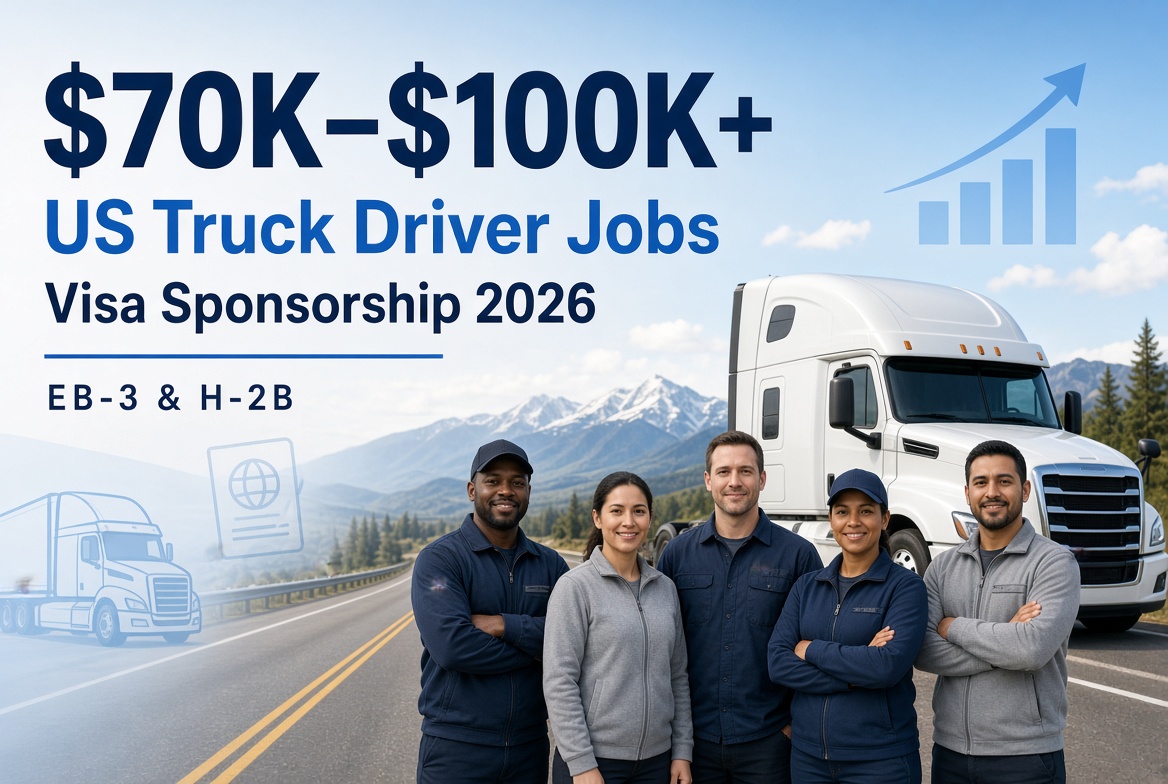
Explore US Truck Driver Jobs With Visa Sponsorship in 2026, including EB-3 and H-2B pathways, CDL requirements, truck driver salaries, employer sponsorship and legal immigration options.
Table of Contents
- US Truck Driver Jobs With Visa Sponsorship: What Foreign Workers Should Know
- How Much Do Truck Drivers Earn in the United States?
- Can a U.S. Trucking Company Sponsor a Foreign Driver?
- EB-3 Sponsorship for Truck Drivers
- H-2B Visa Jobs for Truck Drivers
- EB-3 vs. H-2B for Foreign Truck Drivers
- The 2026 CDL Rules Foreign Drivers Need to Understand
- Basic Requirements for U.S. Truck Driver Jobs
- Where Foreign Workers Can Find Legitimate Sponsorship Opportunities
- What Employers Look for in International Truck Drivers
- Documents to Prepare Before Applying
- How the U.S. Truck Driver Visa Sponsorship Process Works
- Truck Driver Salary Factors in 2026
- How to Avoid Truck Driver Visa Sponsorship Scams
- Frequently Asked Questions
- Final Thoughts
- Author Box
US Truck Driver Jobs With Visa Sponsorship: What Foreign Workers Should Know
US Truck Driver Jobs With Visa Sponsorship continue to attract international applicants who want access to the American transportation and logistics industry.
The opportunity is real, but the immigration side requires careful attention.
A U.S. trucking company cannot simply hire someone overseas and automatically provide a visa because the company needs drivers. The employer, position, immigration category, labor-certification requirements and driver’s licensing status must all fit the applicable federal rules.
This distinction is particularly important in 2026 because commercial driver’s license rules for foreign-domiciled drivers have changed.
The Federal Motor Carrier Safety Administration (FMCSA) issued a 2026 final rule limiting eligibility for non-domiciled commercial learner’s permits and commercial driver’s licenses to certain foreign nationals in specified employment-based nonimmigrant statuses. FMCSA’s current guidance identifies H-2A, H-2B and E-2 as the qualifying employment-based nonimmigrant statuses for non-domiciled CDL eligibility under the federal rule.
That means international truck drivers should not rely on older articles claiming that almost anyone with employment authorization can obtain a U.S. non-domiciled CDL.
The rules have changed.
For foreign workers considering U.S. truck driving careers, two immigration concepts are especially important:
- EB-3 employment-based immigration, which can potentially lead to permanent residence when the position and worker satisfy the requirements.
- H-2B temporary worker status, which is designed for qualifying temporary nonagricultural employment.
The two programs are fundamentally different. EB-3 is an immigrant pathway, while H-2B is temporary.
How Much Do Truck Drivers Earn in the United States?
Truck driving remains a significant occupation within the U.S. transportation and logistics industry.
According to the U.S. Bureau of Labor Statistics (BLS), the median annual wage for heavy and tractor-trailer truck drivers was $58,640 in May 2025, while the highest 10 percent earned more than $79,380. The BLS also reported approximately 2.22 million heavy and tractor-trailer truck driver jobs and projected about 83,800 openings annually, on average, from 2025 through 2035.
These figures are useful for understanding the market, but they should not be interpreted as a guaranteed salary for a foreign worker.
Truck driver compensation can vary substantially depending on:
- Type of freight
- Miles driven
- Regional or long-haul routes
- Employer
- Experience
- Specialized endorsements
- Location
- Bonuses
- Safety record
- Overtime or additional compensation arrangements
- Employee versus other compensation structures
The BLS notes that heavy truck and tractor-trailer drivers are often compensated based partly on miles driven and may also receive bonuses.
For this reason, a job advertisement offering an unusually high annual salary should be examined carefully. A headline such as “$100,000 truck driver salary” does not necessarily mean every driver will receive $100,000 in guaranteed base wages.
Applicants should always ask for the actual written compensation structure.
Can a Trucking Company Sponsor a Foreign Driver?
Yes, a U.S. employer may sponsor a foreign worker in an appropriate immigration category when the job and worker satisfy the requirements of that category.
However, “visa sponsorship available” does not mean every trucking company sponsors drivers.
The employer must use an immigration route that legally applies to the position.
For permanent employment, one possible route is employment-based third preference immigration, commonly known as EB-3.
For qualifying temporary employment, an employer may potentially use the H-2B program.
The U.S. Department of Labor explains that its foreign labor certification programs allow U.S. employers to hire foreign workers on a temporary or permanent basis when the relevant requirements are met, including requirements concerning the availability of U.S. workers and wages and working conditions.
This means foreign applicants should focus their search on employers that have a genuine immigration strategy rather than simply searching for any trucking vacancy.
EB-3 Sponsorship for Truck Drivers
EB-3 is one of the most important employment-based immigration categories for foreign workers researching permanent employment in the United States.
The category includes:
- Skilled workers
- Professionals
- Other workers
For a truck driver position, the classification depends on the actual requirements of the job and the applicable immigration rules.
A job does not become EB-3 eligible merely because an employer calls it a “truck driver job.”
For qualifying EB-3 skilled-worker positions, the job generally must require at least two years of training or experience, while the “other workers” category covers certain permanent positions requiring less than two years of training or experience. USCIS materials describe these distinctions and the employer-sponsored nature of the EB-3 process.
How the EB-3 Truck Driver Process Generally Works
A typical employer-sponsored EB-3 case can involve several stages.
Employer identifies a permanent full-time position
The employer must have a genuine permanent job opportunity with defined requirements and duties.
Prevailing wage determination
The employer generally obtains a prevailing wage determination from the Department of Labor.
Recruitment and labor certification
The employer undertakes the required recruitment process and files a PERM labor certification application where required.
The Department of Labor explains that PERM certification is intended to establish that there are not sufficient U.S. workers who are able, willing, qualified and available for the job and that employment of the foreign worker will not adversely affect the wages and working conditions of similarly employed U.S. workers.
Form I-140
After the labor certification stage, an eligible employer generally proceeds with the immigrant petition process through USCIS.
Immigrant visa or adjustment of status
If the petition and subsequent requirements are satisfied, the worker may proceed through immigrant visa processing abroad or adjustment of status if eligible.
The precise process depends on the applicant’s circumstances and visa availability.
The important point is that EB-3 sponsorship is an employer-driven immigration process. A foreign applicant should not assume that paying a third party will create an EB-3 job.
H-2B Visa Jobs for Truck Drivers
The H-2B program is designed for qualifying temporary nonagricultural employment.
USCIS explains that an H-2B employer generally must establish that its need is temporary, such as a one-time occurrence, seasonal need, peak-load need or intermittent need; that there are insufficient U.S. workers available for the temporary work; and that employing H-2B workers will not adversely affect similarly employed U.S. workers.
Employers generally must also obtain temporary labor certification before filing the petition with USCIS.
This creates an important limitation for people searching specifically for H-2B truck driver jobs.
A permanent, year-round trucking position does not automatically qualify for H-2B simply because a company needs more drivers.
The employer must establish the required temporary need.
H-2B Has Numerical Limits
The H-2B category is also subject to statutory numerical limitations, although Congress and the executive branch have provided additional allocations or exemptions in certain circumstances.
USCIS has explained that the regular statutory H-2B cap is 66,000 workers per fiscal year, divided between the first and second halves of the fiscal year, subject to applicable rules and additional allocations.
Therefore, an employer having an H-2B position does not necessarily mean that a visa will immediately be available.
H-2B Country Eligibility Matters
Another issue international applicants must examine is nationality eligibility.
DHS periodically publishes the countries whose nationals are eligible to participate in the H-2A and H-2B programs. Nationals of countries outside the designated list may potentially qualify in limited circumstances under a discretionary U.S.-interest exception.
Applicants should therefore check the current USCIS H-2B country eligibility information rather than relying on an old blog post or recruitment advertisement.
This is especially important for applicants from countries whose eligibility status has changed or who are considering a recruitment agency claiming that nationality restrictions do not matter.
EB-3 vs. H-2B for Foreign Truck Drivers
The differences can be summarized as follows:
| Feature | EB-3 | H-2B |
|---|---|---|
| General purpose | Permanent employment immigration | Temporary nonagricultural employment |
| Potential Green Card pathway | Yes, if all requirements are met | No direct Green Card through H-2B itself |
| Employer sponsorship | Required for employer-sponsored cases | Required |
| Job nature | Permanent position | Temporary qualifying need |
| Labor certification | PERM generally relevant where required | Temporary labor certification generally required |
| CDL considerations | Must satisfy applicable CDL rules | Must satisfy applicable CDL rules |
| Best suited to | Qualifying permanent jobs | Qualifying temporary jobs |
Neither category should be viewed as a guaranteed route.
The correct immigration option depends on the employer, job structure, worker qualifications, immigration history and current law.
The 2026 CDL Rules Foreign Drivers Need to Understand
This is one of the most important sections of this guide.
A foreign truck driver may have years of professional driving experience in another country and still need to satisfy U.S. commercial licensing requirements.
FMCSA’s 2026 final rule specifically addresses non-domiciled commercial learner’s permits and CDLs.
Under current FMCSA guidance, foreign-domiciled individuals must provide evidence of lawful immigration status and be in one of the specified employment-based nonimmigrant statuses—H-2A, H-2B or E-2—to obtain a non-domiciled CLP or CDL under the federal framework.
The change is significant because older online information may describe broader eligibility based on employment authorization documents.
FMCSA states that earlier guidance allowing certain foreign drivers to qualify through an employment authorization document was rescinded effective March 16, 2026.
Why This Matters for International Applicants
Before accepting a truck driving offer, a foreign worker should determine:
- Whether the employer can legally employ the worker in the proposed status
- Whether the worker qualifies for the required CDL or CLP
- Whether the state licensing agency can issue the necessary credential
- Whether the driver’s immigration status satisfies the current federal CDL requirements
- Whether the applicant needs a particular class of CDL
- Whether endorsements are required for the intended freight
- Whether medical certification and other safety requirements apply
Do not spend money on an overseas trucking recruitment package until you understand how the licensing and immigration requirements fit together.
Basic Requirements for U.S. Truck Driver Jobs
Specific requirements vary by employer and position, but applicants should generally expect employers to examine several areas.
Commercial Driver’s License
A CDL is central to most professional heavy-truck driving positions.
Applicants may need the appropriate CDL class and endorsements for the equipment and cargo involved.
Driving Experience
Some companies recruit entry-level drivers, while others require substantial commercial driving experience.
Experience with:
- Tractor-trailers
- Tankers
- Refrigerated freight
- Flatbeds
- Dry vans
- Specialized freight
- Long-haul routes
can influence job eligibility and compensation.
Driving Record
Employers commonly evaluate driving history and safety records.
A clean record can be important for insurance and employer hiring decisions.
Medical Requirements
Commercial drivers must satisfy applicable federal and state medical requirements.
Applicants should use current FMCSA and state licensing information rather than assuming that a foreign medical certificate automatically satisfies U.S. requirements.
English and Communication
Truck drivers must be able to understand applicable safety information, communicate effectively and comply with workplace requirements.
The exact testing and licensing requirements should be confirmed with the relevant state licensing authority and FMCSA.
Where Foreign Workers Can Find Legitimate Sponsorship Opportunities
Finding the employer is often more important than finding a generic “visa sponsorship jobs” website.
Potential sources include:
Company career pages
Search the career sections of major trucking, freight transportation, logistics and distribution companies.
U.S. Department of Labor resources
The Department of Labor’s Foreign Labor Certification resources provide information about employer labor certification programs and public disclosure data.
USCIS
Use USCIS for immigration-category requirements and petition information.
State CDL agencies
Because licensing is administered through state systems under federal standards, applicants should verify licensing requirements with the relevant state agency.
Reputable employment platforms
Commercial employment websites can help identify vacancies, but applicants should independently verify the employer and sponsorship claim.
A good rule is simple:
Verify the employer first. Verify the immigration pathway second. Pay money only after understanding exactly what the payment is for.
What Employers Look for in International Truck Drivers
An overseas applicant can strengthen an application by presenting a professional employment profile rather than simply stating, “I need visa sponsorship.”
A strong application may include:
- Current CV/resume
- Commercial driving history
- License information
- Driving experience by vehicle type
- Accident history
- Safety record
- Employment references
- Relevant training certificates
- Passport information when appropriate
- Professional driving qualifications
- Availability
- Preferred routes
- Experience with specialized freight
A U.S.-style resume should make the candidate’s experience easy to understand.
For example, instead of writing:
“Worked as a driver for many years.”
A stronger description would explain the vehicle type, years of experience, route type, cargo and safety responsibilities.
Documents to Prepare Before Applying
International applicants should organize their documentation before beginning an aggressive job search.
Common documents may include:
- Valid passport
- Driver’s license
- Commercial driving credentials
- Driving record
- Employment references
- Training certificates
- Educational records where relevant
- Proof of work experience
- Medical documentation where applicable
- Police or background documentation when required
- Immigration documents, if already in the United States
Never send original identity documents to an unknown recruiter.
Use secure application channels and verify the company’s identity.
How the U.S. Truck Driver Visa Sponsorship Process Works
The process depends heavily on the immigration category.
For a potential EB-3 case, the employer may need to complete the PERM labor certification process before proceeding with the immigrant petition. The Department of Labor’s official PERM guidance explains the prevailing wage, recruitment and certification stages.
For an H-2B case, the employer generally establishes temporary need and completes the required labor certification process before the USCIS petition stage.
Once an approved petition permits visa processing, a worker applying from outside the United States normally proceeds through the U.S. Department of State’s immigrant or temporary-worker visa procedures, depending on the category.
The State Department explains that temporary workers must qualify for the relevant employment visa category and that petition-based temporary workers generally need the appropriate approved petition information when applying.
For current immigration procedures, applicants should use:
USCIS — Official Immigration Website
U.S. Department of State — Employment Visas
U.S. Department of Labor — Foreign Labor Certification
FMCSA — Official Commercial Driver Information
These government sources should take priority over social media posts, recruitment messages and unofficial immigration websites.
Truck Driver Salary Factors in 2026
The national median is useful as a benchmark, but truck driver income is not uniform.
BLS data show a May 2025 median annual wage of $58,640 for heavy and tractor-trailer truck drivers. The highest 10 percent earned more than $79,380.
Specialized employment can produce different compensation structures.
Factors affecting earnings can include:
Long-Haul Trucking
Long-haul drivers may spend extended periods away from home and may be compensated according to miles, loads, bonuses or other structures.
Specialized Freight
Drivers handling specialized equipment or cargo may face additional qualifications and responsibilities.
Tanker and Hazmat Work
Additional endorsements and compliance requirements may apply.
Team Driving
Some employers operate team-driving models where two drivers share driving responsibilities.
Regional Driving
Regional positions may offer different schedules and compensation structures from national long-haul work.
Experience
Experienced drivers with strong safety records may have access to different job opportunities than newly qualified drivers.
Applicants should compare guaranteed base compensation, mileage rates, bonuses, deductions, benefits, home-time policies and reimbursement arrangements, rather than focusing only on the headline annual salary.
How to Avoid Truck Driver Visa Sponsorship Scams
International recruitment fraud is an important concern.
A legitimate job offer should not require you to blindly trust a recruiter who promises guaranteed immigration approval.
Be cautious if someone claims:
- “Guaranteed U.S. visa”
- “Guaranteed Green Card”
- “Pay today or lose your slot”
- “No interview required”
- “No CDL needed”
- “Everyone gets approved”
- “The embassy cannot reject you”
- “Send money to my personal account”
- “Buy a visa sponsorship certificate”
- “Pay us for a guaranteed EB-3”
These statements should trigger serious verification.
The U.S. Department of State provides legal-rights information for H-2B workers, including protections concerning recruitment fees and employment conditions. Its guidance states that H-2B workers should not have to pay labor recruiters fees and provides information about transportation and other protections.
This makes it particularly important to distinguish legitimate employer-related costs from questionable recruitment charges.
If a recruiter says you must pay thousands of dollars for a “guaranteed H-2B visa,” stop and verify the claim through official government sources.
Frequently Asked Questions
Can truck drivers get U.S. visa sponsorship in 2026?
Potentially, yes, but sponsorship depends on the specific employer, position and immigration category. EB-3 may apply to qualifying permanent employment, while H-2B applies only to qualifying temporary nonagricultural employment.
Is EB-3 available for truck drivers?
A truck driver position can potentially be sponsored under an EB-3 classification if the position and worker satisfy the applicable requirements and an employer is willing and able to sponsor the worker. The job must meet the relevant EB-3 and labor-certification requirements.
Can H-2B be used for trucking jobs?
Potentially, but H-2B requires qualifying temporary need. A normal permanent year-round trucking vacancy does not automatically qualify for H-2B.
What is the average U.S. truck driver salary?
The BLS reported a median annual wage of $58,640 for heavy and tractor-trailer truck drivers in May 2025. Compensation varies considerably by employer, location, route, experience and compensation structure.
Can I use my foreign commercial driver’s license in the United States?
Do not assume that a foreign CDL automatically permits you to operate a commercial motor vehicle in the United States. FMCSA states that only Mexican and Canadian commercial licenses have specific reciprocity recognition under the federal framework, while other foreign drivers may need to satisfy U.S. licensing requirements.
The 2026 non-domiciled CDL rules also significantly affect foreign-domiciled applicants.
Can I obtain a U.S. CDL while on H-2B status?
Current FMCSA guidance specifically identifies H-2B as one of the employment-based nonimmigrant statuses under which a foreign-domiciled individual may qualify for a non-domiciled CLP or CDL, provided the other requirements are satisfied.
Does an EB-3 truck driver automatically receive a Green Card?
No. Employer sponsorship does not mean automatic permanent residence. The employer, job, worker and immigration case must satisfy the applicable requirements, and visa availability and other immigration procedures can affect the process.
Where should I verify U.S. visa sponsorship information?
Start with USCIS, the U.S. Department of Labor, the U.S. Department of State and FMCSA. These agencies provide the official information governing immigration, labor certification and commercial driving requirements.
Final Thoughts
US Truck Driver Jobs With Visa Sponsorship can provide an avenue for qualified international drivers to explore employment in the American transportation industry, but applicants need to approach the opportunity as an immigration-and-employment process rather than simply a job search.
The most important distinction is between permanent EB-3 sponsorship and temporary H-2B employment.
EB-3 can be relevant when a U.S. employer has a qualifying permanent position and completes the required employment-based immigration process. H-2B, by contrast, is designed for qualifying temporary nonagricultural employment and is subject to additional requirements and numerical limitations.
The CDL side is equally important in 2026. FMCSA’s current rules mean foreign-domiciled applicants should verify their eligibility under the updated non-domiciled CDL framework before making relocation plans or paying for training.
For salary planning, BLS data provide a useful benchmark: the median annual wage for heavy and tractor-trailer truck drivers was $58,640 in May 2025, with the highest 10 percent earning more than $79,380. Actual earnings can differ significantly according to the job and compensation structure.
Most importantly, foreign applicants should verify every sponsorship claim.
A legitimate employer should be identifiable. The job should be genuine. The immigration category should match the employment. The licensing requirements should be understood. And no recruiter should be allowed to replace official U.S. government information with promises of guaranteed approval.
For anyone considering a U.S. trucking career in 2026, the safest starting point is to verify the opportunity through official government resources before committing money, documents or travel arrangements.
Official Government Resources
USCIS — U.S. Citizenship and Immigration Services
U.S. Department of Labor — Foreign Labor Certification
U.S. Department of State — Employment Visas
FMCSA — Commercial Driver Licensing Information
BLS — Heavy and Tractor-Trailer Truck Drivers
Author Box
Dynamo Gills
Writer & Researcher at Jobs Biodynasty
Dynamo Gills writes about international employment, immigration pathways, scholarships, professional development and global career opportunities, with a focus on practical information that helps readers understand requirements before making important career or relocation decisions.
Editorial note: Immigration and employment regulations can change. Readers should verify current requirements directly with the relevant U.S. government agency before applying, paying fees, accepting employment or making travel arrangements.


 Dynamo Gills